









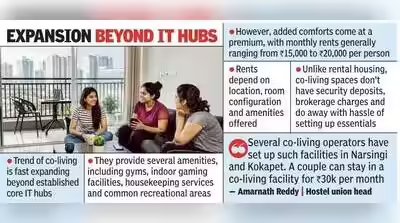

Hyderabad: As housing rentals continue to climb year after year, the western corridor has emerged as a hotspot for co-living spaces, witnessing a tenfold increase in the number of co-living spaces over the past four years.According to IT corridor hostels association, Hyderabad, which had barely 20 co-living spaces during the pandemic years, now has more than 250 such facilities. This growth is being driven by the changing accommodation preferences among young working individuals. Over 90% of them are concentrated in key IT hubs such as Gachibowli, Hitec City, Kondapur, Kukatpally and Miyapur.PGs transform into co-living spacesIf that’s not all, co-living spaces now account for nearly 5% of the approximately 4,500 hostels catering to both men and women in the Cyberabad region. Hostel operators say the surge has largely been fueled by the conversion of traditional paying guest (PG) accommodations and hostels into modern co-living facilities.“Many hostels with low occupancy levels have rebranded themselves as co-living spaces to attract young professionals and bachelors. Most operators no longer use terms such as hostel or PG in their branding and instead market themselves exclusively as co-living spaces. This concept has become increasingly commercialized in recent times, with growing demand from employees seeking a community-oriented lifestyle combined with convenience and modern amenities,” said V Mahidhar, owner of women’s PG in Gachibowli.Feels like home: Co-liversResidents say co-living spaces offer a unique blend of privacy, comfort and social interaction that is often missing in conventional rental housing. “I moved from Delhi to Hyderabad in 2019 and initially lived in an apartment. About three years later, I came across the co-living concept and decided to move into one. I was surprised by how much I liked it. I have a private room with all the facilities I need. It feels like a hotel, yet also like a home. There are no restrictions, and I can even have my family and children visit me,” said Ashish Lal, who stays in Buzz Quarter, Khajaguda.Many also highlight the social advantages of co-living. Shared cafeterias, common areas and community events provide opportunities to interact with people from diverse backgrounds. “Before and after work, we meet different people and have meaningful conversations. In an apartment, you usually interact with only a couple of people. In co-living spaces, you get to know many residents, some of whom become close friends and feel like family,” said V Sanjay Chowdhary, another resident of the co-living space in Gachibowli.Expansion beyond core IT hubsThe trend is also expanding beyond the established IT hubs. “Several co-living operators have recently set up such facilities in residential destinations such as Narsingi and Kokapet. Some working couples are also opting for co-living spaces instead of renting apartments, as these facilities offer security, food services and lifestyle amenities at competitive prices. A couple can typically stay in a co-living facility for around Rs 30,000 per month,” Amarnath Reddy, head of IT corridor hostels association.These co-living spaces provide a range of premium amenities, including gyms, indoor gaming facilities, housekeeping services and common recreational areas. However, these added comforts come at a premium, with monthly rents generally ranging from Rs 15,000 to Rs 20,000 per person, depending on location, room configuration and amenities offered.Operators also say unlike traditional rental housing, co-living spaces eliminate the need for security deposits, brokerage charges and the hassle of setting up household essentials as they are provided with fully furnished rooms and meals under a single monthly payment, making the model particularly attractive to newcomers.High occupancy levels, growing demandOperators say occupancy levels in well-managed co-living facilities across prime IT locations remain high throughout the year. The majority of residents are aged between 22 and 35 years and work in information technology, financial services and startup firms. They say that this co-living segment is likely to witness further consolidation, with many players expanding their portfolios and introducing premium offerings targeted at working professionals.Apps simplify accommodation searchMeanwhile, to tap into the growing demand for co-living spaces, several mobile apps and online platforms have emerged, enabling users to search, compare and book accommodations based on their preferences. These platforms allow prospective bachelors to customize their requirements, such as location, budget, room-sharing options and amenities, helping them choose a co-living space that suits their lifestyle and needs.