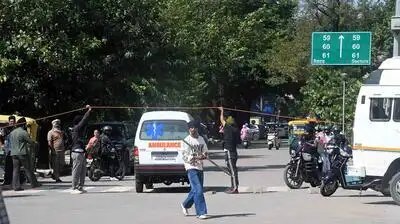









Chandigarh: With rising traffic volumes making it increasingly difficult for pedestrians to cross some of Chandigarh’s busiest roads, the UT Administration has drawn up plans to build a network of pedestrian underpasses at key intersections across the city. The engineering department has initiated the process to appoint a consultant to carry out topographical surveys and digital mapping for the proposed projects, marking the first step towards expanding pedestrian infrastructure.The feasibility study will initially focus on the city’s busiest roads and junctions, including Housing Board Chowk, from Junction-21 to 42, Junction-25 to 28 and Junction-27 to 34. Officials said these intersections and roads witness some of the highest traffic volumes and will be assessed for engineering feasibility, traffic patterns, junction geometry and pedestrian movement before finalising the locations.“These are among the city’s busiest corridors. The consultant will examine traffic volume, junction design and the technical feasibility of constructing pedestrian underpasses at these locations,” a senior UT official said.The move comes at a time when Chandigarh’s roads are carrying unprecedented traffic loads. With nearly 15 lakh registered vehicles—more than the city’s estimated population—pedestrians are finding it increasingly difficult to negotiate wide arterial roads such as Madhya Marg, Dakshin Marg and Jan Marg, particularly during peak hours.At present, Chandigarh has only two operational pedestrian underpasses, both in Sector 17. One connects the Plaza to Sector 16 while the other links it with Sector 22. Despite the city’s pedestrian-friendly planning principles, most major crossings still rely on surface zebra crossings regulated by traffic signals.The Administration is also moving ahead with its long-pending pedestrian underpass between Panjab University and PGIMER, which has now entered the tender evaluation stage. The project will cost around Rs 8 crore. Officials have set a target of completing the project by December 2026.The underpass is expected to provide a safe crossing for over 10,000 daily users, including students, doctors, patients and hospital attendants, who currently cross the busy Madhya Marg amid fast-moving traffic. Proposed in 2019 after repeated safety concerns flagged by Chandigarh Traffic Police, the project remained stalled for years because of land availability issues before being redesigned to fit entirely within government land.Officials said the PU-PGIMER underpass is likely to serve as a model for similar projects across the city. Earlier traffic studies by RITES had also identified several high-risk pedestrian corridors requiring grade-separated crossings, including Dakshin Marg between Sectors 22 and 35 and a proposed internal pedestrian link between Panjab University’s north and south campuses.“The Administration believes the proposed underpasses will improve pedestrian safety, reduce conflicts between vehicles and pedestrians, and ensure smoother traffic flow at Chandigarh’s busiest intersections without disrupting signal cycles,” said the official.