






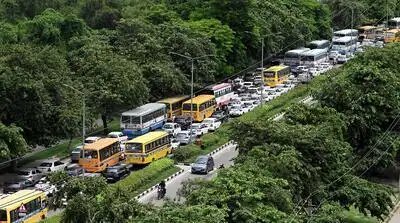
Having a private vehicle is essential for anyone who wants to travel in Chandigarh. Private vehicles now account for nearly four out of five passenger trips in the Tricity. Over the past two decades, authorities have examined Metro, MetroLite, MetroNeo, BRT, trolley buses, Ring Rail, Monorail and Skybus — but not one mass transit project has reached implementation stage.Every year, nearly 50,000 new vehicles are added to Chandigarh’s roads. Yet, even as congestion steadily worsens, the city’s search for a mass transit solution stretches endlessly. Over the past two decades, planners and govts have examined at least eight alternatives, including light trams. The latest Comprehensive Mobility Plan backs Metro as the only long-term solution, but mounting costs have again stalled the project again, prompting the UT administration to explore cheaper alternatives instead.Inevitability of private vehiclesThe road network has not kept pace with the traffic volume, which has strained infrastructure. Traffic counts conducted by RITES show that private vehicles account for between 79% and 90% of traffic at major junctions, while the share of public transport and intermediate public transport varies between 4.1% and 16.8%. Buses — considered the backbone of urban mobility — constitute just 0.4% to 2.6% of traffic at the busiest intersections.The dominance of private vehicles is even more pronounced at individual junctions. Fast passenger vehicles account for 97% of traffic at Budanpur Chowk and 87.5% at Chandigarh Railway Station Road Junction. At Gurdwara Chowk, private vehicles make up 93% of all traffic while buses account for only 0.9%. Similar trends are visible at Kisan Bhawan (1%), Kumbra Chowk (0.8%), Transport Chowk (0.9%), Press Chowk (1.6%) and Sector 43/35 Chowk (1.6%). Even at ISBT-17, where bus presence is naturally the highest, buses account for only 2.5% of the traffic mix.Spiralling car ownership ratesThe challenge is magnified by Chandigarh’s exceptionally high vehicle ownership. According to the mobility study, the Tricity has around 251 cars for every 1,000 residents, among the highest ownership rates in the country.Chandigarh Traffic Police data shows a steady rise in the registered vehicle fleet over the past decade, crossing 13.7 lakh vehicles in 2023. This has placed increasing pressure on a city where the road network has limited scope for expansion.The Chandigarh Master Plan-2031 warned that the city’s V-2 and V-3 roads would suffer increasing congestion because personalised transport was growing much faster than public transport, with little room to widen roads within the existing urban fabric.How the Tricity movesThe travel pattern itself reflects the city’s dependence on private mobility. The Tricity generates 37.3 lakh trips every day, of which 80% are vehicular and only 20% are on foot.Two-wheelers alone account for 34% of all trips, while buses account for just 16% across the Tricity and 17% within Chandigarh. Around 42% of all trips are for work or business and another 36% for education, making dependable public transport critical for daily commuting.Trip purpose data underlines the pressure on the transport network. Among motorised commuters, 35.5% travel for education, 33.6% for work and 16.6% for business. Walking is largely confined to shopping and educational trips.Travel cost patterns indicate that commuters continue to spend significantly more on private transport. More than half of all car trips cost between Rs 30 and Rs 70, while one-third cost over Rs 70. By comparison, about 40% of bus users spend more than Rs 20 per trip, suggesting that convenience and reliability, rather than fare alone, influence commuters’ choices.The losing bus systemDespite CTU expanding its fleet from just 30 buses in 1966 to more than 400 today, the city’s dependence on buses has declined rather than increased.A CEPT University study commissioned by the ministry of housing and urban affairs found that bus services cover only 38% of Chandigarh’s road network and 43% of the Tricity road network.Most routes converge on ISBT-17, ISBT-43 and PGI, creating congestion on trunk corridors while leaving several areas inadequately connected. No route offers bus frequencies below 10 minutes, fleet utilisation is only 88%, and average utilisation is below the desired benchmark. Bus occupancy is also poor, with load factors ranging between 0.24 and 0.36, meaning 70-80% of seating capacity often remains vacant.Passenger surveys point to the same shortcomings. Just 29% of commuters identified frequent bus services as their top priority, followed by safety (21%), affordable fares (15%), travel time savings (13%) and last-mile connectivity (11%).Several solutions, zero implementationThe need for a Mass Rapid Transit System (MRTS) was recognised more than two decades ago.The first major proposal was an electric trolley bus. In 2001, BHEL prepared a detailed project report for a 39-km trolley bus corridor linking Chandigarh, Mohali and Panchkula. The proposal was eventually dropped over aesthetic concerns, and tree cutting issues.Attention then shifted to a Metro, which was incorporated into the Chandigarh Master Plan-2031 before being shelved due to financial and political constraints.Nearly five years ago, the administration revived the exercise and asked RITES to prepare a fresh comprehensive mobility plan. The consultant evaluated conventional buses, Bus Rapid Transit (BRT), MetroNeo, MetroLite and Metro Rail.Its conclusion was clear. Conventional buses, BRT and MetroNeo were ruled out because they would not be able to meet future passenger demand or faced right-of-way constraints. MetroLite emerged as a possible option but was projected to reach saturation around 2054-55. Only a Metro Rail system, RITES concluded, would be capable of handling projected passenger demand well beyond 2056.Even as the metro proposal awaits a final decision, the debate has taken another turn.Speaking at a Meet-the-Press programme at the Chandigarh Press Club in Jan this year, UT administrator Gulab Chand Kataria questioned the financial viability of a standalone metro for Chandigarh, citing Jaipur as a cautionary example.“Metro looks attractive, but Jaipur’s project couldn’t even recover interest costs. Chandigarh’s limited population and heritage zones make underground construction inevitable, which further inflates expenses,” Kataria said.He instead suggested that metro corridors could terminate on the city’s periphery, linking Chandigarh with Mohali, Panchkula and other adjoining towns, while an efficient bus system provides last-mile connectivity within the city.Kataria also floated light trams as a possible alternative to a conventional metro. The proposal envisages using Chandigarh’s existing 200-km network of dedicated cycle tracks as the alignment for tram corridors, reducing the need for large-scale civil works, minimising disruption to the city’s heritage character and preserving Le Corbusier’s original urban design.Over the years, other alternatives have also surfaced, including a Ring Rail using existing railway corridors, a Monorail proposed by former MP Kirron Kher and a double-decker Skybus suggested by Union minister Nitin Gadkari. None has progressed beyond the proposal stage.BOX- Heritage Vs mobilityChandigarh’s traffic crisis is not merely an engineering challenge —it is also a heritage dilemma. As India’s only planned modernist city protected by the Edict of Chandigarh and the Chandigarh Master Plan (CMP)-2031, every major transport proposal must balance mobility with preserving Le Corbusier’s vision of low-rise development, open vistas, tree-lined avenues and an uncluttered skyline.That conflict has repeatedly derailed conventional mass transit solutions. The Punjab and Haryana high court, while hearing a challenge to the Industrial Area flyover, reinforced that the Master Plan prohibits elevated structures that would compromise the city’s heritage character. As a result, large flyovers and elevated metro viaducts within the heritage sectors have effectively become non-starters.The restrictions have also made Chandigarh’s proposed Metro significantly more expensive. Heritage conservation norms require metro corridors passing through the city’s core sectors to run underground, with elevated sections permissible only outside the heritage zone in Mohali and Panchkula. Underground construction is estimated to cost nearly three times as much as elevated corridors, substantially affecting the project’s financial viability.The city’s extensive green canopy presents another hurdle. Road widening, dedicated transit corridors or station construction often require felling mature trees, inviting objections from environmental groups and legal scrutiny. Courts have repeatedly stressed protection of Chandigarh’s tree cover while hearing infrastructure cases.