








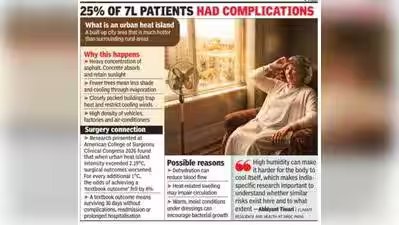

Mumbai: Recovering from major surgery may not depend only on the surgeon and the hospital’s antiseptic cleanliness. Living in a neighbourhood that traps more heat could also affect recovery, a large US study has found.As heat can increase fluid loss and alter the body’s fluid balance, the researchers said post-surgical recovery could be hit.The study, involving nearly 7 lakh patients across the US, found that above an urban heat island intensity of 2.19°C, every additional 1°C was associated with an 8% increase in the odds of patients failing to achieve what researchers called a ‘textbook outcome’. This meant having no complications, no prolonged hospital stay, no readmission and surviving at least 30 days after surgery. Patients with cancer, emergency and high cardiac-risk procedures were particularly at risk.Abhiyant Tiwari, lead, Climate Resilience and Health at NRDC India who wasn’t associated with the study, said, “The connection is quite plausible. Surgery already puts significant stress on the body and heat can add to that through increased fluid loss, dehydration and cardiovascular stress. So, the environment in which a patient recovers could potentially influence their outcomes.”Dr Ajay Bhandarwar, dean of JJ Group of Hospitals, concurred. “Any factor that increases inflammation, raises dehydration risks and worsens cardiovascular and wound-healing stress may delay recovery.” He said an extremely hot environment could, hence, technically affect recovery. “However, there is no substantial evidence to prove that. Delay may be due to complications, especially in major surgical procedures,” he said.As per the American study, 25.2% developed complications, 22.9% had a prolonged hospital stay, 14.8% were readmitted and 7.1% died within 30 days.This observational study was presented at American College of Surgeons Clinical Congress 2026. “Do you have air-conditioning in your house? Do you have a fan? Are you going to be able to stay hydrated?” said senior author Timothy Pawlik of Ohio State University, adding that such questions may increasingly need to form part of discharge planning during hot weather.Tiwari, however, cautioned against directly applying the US findings to India. “Mumbai has its own combination of heat, high humidity, housing conditions, ventilation and access to air-conditioning. High humidity can make it harder for the body to cool itself, which makes India-specific research important to understand whether similar risks exist here and to what extent.”