








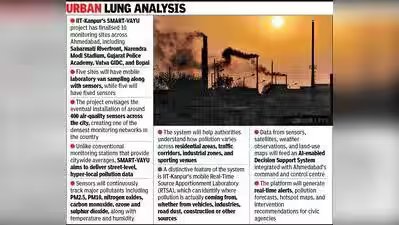
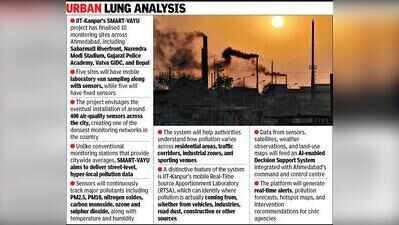
Gandhinagar: Gujarat govt and AMC, in collaboration with IIT-Kanpur, have finalised 10 locations across the city for a new real-time air-quality monitoring initiative to build a data-driven system that identifies pollution hotspots and their sources.The initiative is called SMART—VAYU (Sensing and Monitoring for Air-quality using Real-time Technology—Vision-based Ahmedabad air analYsis for Urban Management).It entails baseline mapping of pollution sources, deployment of a hyper-local monitoring network, and development of a decision-support system for urban air-quality management.The 10 selected sites are Sabarmati Riverfront Sports Complex, Narendra Modi Stadium, Gujarat Police Academy at Karai, Sanskardham, Veer Savarkar Sports Complex, Pirana AMC community service centre, Rakhial AMC health office, Vatva GIDC’s Chandrakala complex, Bopal urban health centre, and Thaltej AMC ward office.“While existing monitoring stations can indicate how polluted the air is, the new system aims to identify where pollution is coming from, how it moves across the city and which locations require immediate intervention,” said a senior AMC official.Another official said, “The first five locations will be used for mobile laboratory van sampling as well as sensor deployment, while the remaining five will have sensors installed.”Officials added that the site-selection exercise considered meteorological and particulate matter data, annual wind patterns, satellite-based aerosol optical depth, and interpolated PM2.5 data, besides practical factors such as power availability, security, accessibility, airflow, and interference from local emission sources.Ahmedabad already has a citywide air-quality monitoring network under the Centre’s System of Air Quality and Weather Forecasting and Research (SAFAR) programme.SAFAR stations are located at Bopal, Satellite, Pirana, Raikhad, Navrangpura, Rakhial, Chandlodia, and the airport, and provide city-level air-quality data and forecasts.According to a presentation made to govt, the project’s timeline shows three monitoring cycles, with the first running from May to Oct 2026, the second from Nov 2026 to Jan 2027, and the third from Feb to April 2027. The deployment of 10 continuously running sensors is scheduled for Oct 2026, a source said.Govt officials said that pilot monitoring has already been carried out at Sabarmati Riverfront Sports Complex and Narendra Modi Stadium.“Monitoring at the riverfront site recorded PM2.5 at 40.4 micrograms per cubic metre, while monitoring at Narendra Modi Stadium recorded 33.1 micrograms per cubic metre,” said an official. Sources added that monitoring has also begun at the Gujarat Police Academy, with preliminary data collection under way.According to officials connected with the project, it is expected to produce baseline source data, high-resolution source maps, and hotspot analysis.“The subsequent phases of the project envisage expansion of the low-cost sensor network across Ahmedabad, specific interventions, and continuous monitoring and integration with the city’s command and control centre,” said an official.PointersUrban lung analysis#IIT-Kanpur’s SMART-VAYU project has finalised 10 monitoring sites across Ahmedabad, including Sabarmati Riverfront, Narendra Modi Stadium, Gujarat Police Academy, Vatva GIDC, and Bopal#Five sites will have mobile laboratory van sampling along with sensors, while five will have fixed sensors#The project envisages the eventual installation of around 400 air-quality sensors across the city, creating one of the densest monitoring networks in the country#Unlike conventional monitoring stations that provide city-wide averages, SMART-VAYU aims to deliver street-level, hyper-local pollution data#Sensors will continuously track major pollutants including PM2.5, PM10, nitrogen oxides, carbon monoxide, ozone and sulphur dioxide, along with temperature and humidity#The system will help authorities understand how pollution varies across residential areas, traffic corridors, industrial zones, and sporting venues#A distinctive feature of the system is IIT-Kanpur’s mobile Real-Time Source Apportionment Laboratory (RTSA), which can identify where pollution is actually coming from, whether from vehicles, industries, road dust, construction or other sources#Data from sensors, satellites, weather observations, and land-use maps will feed an AI-enabled Decision Support System integrated with Ahmedabad’s command and control centre#The platform will generate real-time alerts, pollution forecasts, hotspot maps, and intervention recommendations for civic agenciesSource: IIT Kanpur