











BENGALURU: Private schools in Karnataka are on sale. Dismissed as a one-off distress sale induced by Covid admission inertia, the whole school set-up, along with land and infrastructure, going on sale is becoming more common now, with at least 200 functional schools up for grabs, according to educationists and real estate agents specialising in educational properties.Most of these are standalone, self-sustaining schools affiliated to state or central boards, which are finding it difficult to operate with thin margins and thinner admissions. Since infrastructure upgrades and faculty salaries are eating into their budget, managements are making a quiet exit, handing over the reins to professionally run schools, which are keen on expanding their footprint into smaller towns.Business interactions are currently of three kinds: outright sale with land and infrastructure running into crores; rental or lease agreement ranging from Rs 5 lakh to Rs 40 lakh a month; and the profit-sharing model.
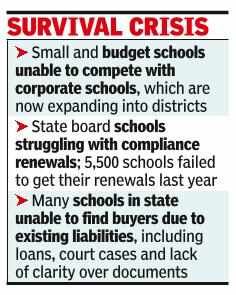
Corporate schools, which have reached near saturation growth in urban centres, are looking at smaller towns for expansion. “It’s akin to kirana shops taken over by supermarkets,” said Prasanna Kumar BG, founder and CEO, Edproperty, a real estate portal exclusively for educational properties.Prasanna claimed around 200 schools are on sale. TOI couldn’t independently verify the numbers since no exact data on this is fully computed so far.Some schools unable to pay maintenance: KAMS secy Prasanna said: “State board schools – operating on smaller premises, with low fee structure – are seeing parents shift their children to bigger schools, especially into CBSE/ICSE curriculum. At the same time, smaller CBSE/ICSE schools are unable to face competition dictated by big brands entering their jurisdiction.”Agreed N Prabhakar Urs, founder of The School Company, which is into sale, rental and lease of schools. “Every corporate school is coming to district headquarters, creating tough competition for small, budget schools. They invest crores of rupees in one go. They have marketing strategies, offer admission-fee waivers, and other offers to attract parents. Their school buses ply up to 50km whereas that of a small school might ply for 15km. They pump in money for infrastructure and branding,” he said.On the other hand, state board schools are struggling with renewal-of-recognition compliances as the department is very stringent with them. Last year, around 5,500 schools in Karnataka did not receive renewals. Family-run schools are also on the block. “The next generation is not interested because this is not glamorous. It’s not easy dealing with everyday problems like complaints from parents, teachers and so on. So the new generation is not inclined to stay with the business,” Prasanna added.D Shashi Kumar, secretary of Management of Primary and Secondary Schools of Karnataka, said Covid was a beginning. “With the dipping population, admissions to kindergarten have decreased across schools, irrespective of the management. Costs have escalated. Some schools with 100-200 students are not able to manage maintenance and are paying out of their pockets. They are all exiting business now,” he said.Shashi Kumar said real estate is the main driver in cities like Bengaluru. “Many investors are now no more educationists. They might be keen on investing in real estate property,” he said.“With newer curriculums, options for parents have widened. National Institute of Open Schooling, for instance, has been having a large patronage now,” said a city school principal.Many schools have not been able to sell because they come with a lot of liabilities. Some schools have invested heavily expecting good admissions but they don’t. These liabilities include loans, court cases and lack of clarity over documents. “Nobody wants to get into that whirlpool. That is why many of them have not been sold,” said the school principal.