








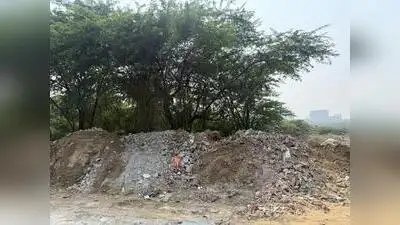
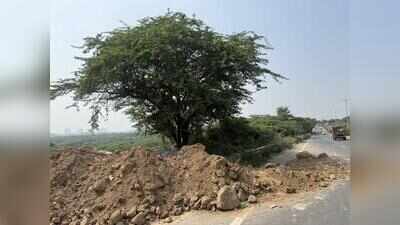
Gurgaon: MCG on Tuesday issued a new set of guidelines for the collection, transportation, processing and utilisation of construction and demolition (C&D) waste. These new guidelines were also submitted to Punjab and Haryana high court on Monday. Through two official orders, issued by commissioner Pradeep Dahiya, MCG has issued specific compliance requirements for demolition projects, large construction projects, govt works and road, sewer and water-supply projects.According to the first order, projects involving demolition on plots measuring 200 square metres or more will have to declare the estimated quantity of C&D waste expected to be generated when applying for building-plan approval. Before construction or reconstruction begins, the demolition waste must be deposited at MCG’s authorised processing facility, presently at Basai, or another designated collection point or facility notified by MCG. The applicant must obtain a deposition receipt through MCG C&D portal.Applicants or developers of projects with a built-up area of 20,000 square metres or more will have to prepare an integrated waste management plan and submit it to MCG through its portal for approval. C&D waste generated by these projects will have to be deposited by the producer at an MCG recycling facility using its own vehicles. The deposit of C&D waste will be routed through MCG’s C&D portal, which was recently launched.TOI reported on Aug 16 that HC had asked Haryana urban local bodies department and MCG to frame a universal SOP with fixed timelines for clearing debris left behind after civic work, saying residents should not have to approach the court every time a road is dug up and left in a mess. The order came on a petition filed by city resident and lawyer Pankaj Yadav, who alleged that a road outside his Sector 22 house was left covered with excavated earth, mud and debris after MCG undertook work to lay a water pipeline. The order by Justice Pankaj Jain had sought to address a recurring civic problem. As the hearing on the matter was scheduled on Tuesday, the civic body submitted the SOPs as part of its affidavit on Monday.The second order deals with govt departments and govt-executed works, including works undertaken by MCG itself. Departments will also have to specify in their tenders the estimated quantity of C&D waste expected to be generated during a project. Contractors will be required to provide documentary proof establishing that the waste has been safely deposited. The order makes deposition of C&D waste generated by govt projects at MCG’s authorised processing/recycling facility at Basai, or at another facility subsequently notified by MCG, mandatory irrespective of the size or monetary value of the project.The requirement has a direct consequence for building approvals: no occupation certificate (OC) or completion certificate will be granted until proof of demolition-waste deposition has been submitted and verified through MCG portal.The order goes beyond disposal and mandates the reuse of processed C&D material in govt construction, reconstruction and road projects. MCG has determined that govt projects will be treated as “producer-equivalent” for this purpose, meaning the requirement applies irrespective of the built-up area of the project.Significantly, time limits have been prescribed for removing surplus excavated material and C&D waste generated during infrastructure works by the govt agencies. For right-of-way repair or restoration works, the material will have to be removed within 48 hours of completion. In road repair, resurfacing and restoration works, the maximum period will be 72 hours. Waste and surplus material from sewer-line works will have to be removed within 72 hours of completion, while material generated during water-supply line works will also have to be cleared within 72 hours. C&D waste generated during construction, renovation, reconstruction and demolition of buildings by the govt agencies will have to be stored at designated locations and waste deposited at public places will have to be removed within 24 hours.The civic body will also establish a C&D monitoring cell to oversee implementation of the guidelines. The cell will be chaired by additional commissioner Yash Jaluka and will include a junior engineer and two operators. The cell will monitor compliance by contractors and govt departments through MCG’s C&D monitoring mechanism and portal and submit reports recommending necessary action in cases of violations. The two separate orders are in accordance with the Environment (Construction and Demolition Waste) Management Rules, 2025, Haryana’s C&D Waste Management Policy, 2019 and directions issued by Commission for Air Quality Management.