









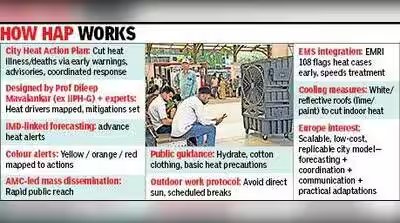
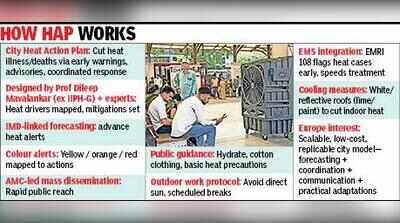
Ahmedabad’s landmark Heat Action Plan (HAP), born out of tragedy in the summer of 2010, is now being studied as a possible template for European cities grappling with intensifying heatwaves. The plan—credited with saving thousands of lives through early warnings and coordinated interventions—will be showcased this week at the CLARA Summer School on Climate Change and Health at the Czech University of Life Sciences (CZU), Prague, from Sept 3 to 9.It was the 1,300-plus all-cause excess deaths in Ahmedabad during the 2010 summer that pushed experts at the Indian Institute of Public Health, Gandhinagar (IIPH-G), along with other stakeholders, to create South Asia’s first comprehensive HAP. Launched in 2013 with the Ahmedabad Municipal Corporation (AMC) and partner organisations, the programme introduced a structured system of heat alerts and public messaging that has since been replicated and adapted in other Indian cities.The renewed interest from Europe comes after this year’s severe heat waves across the continent. As temperatures rose to record levels, reports suggested thousands of excess deaths in Germany, France, Spain and the UK, prompting policymakers and public health institutions to look beyond traditional responses.Prof Mahaveer Golechha from IIPH-G will participate in the Prague event, focusing on the cascading impacts of extreme heat. He will speak on ‘India’s Heat Action Plan: A Successful Public Health Policy for Extreme Heat in the Global South’.“I will highlight the work in cities of Ahmedabad and Rajkot in prioritizing heatwaves through efficient early warning systems, effective inter-department coordination and governance, large scale community awareness, and community led initiatives for enhancing resilience against extreme heat,” he said. “The emphasis will be on the lessons from Gujarat and India that can be useful for European cities for reducing excess morbidity and mortality due to extreme heat.”Experts said discussions will also include data-driven decision-making, nature-based solutions, ecosystem-based disaster risk reduction, improved infrastructure for a climate-resilient health system, and cost-effectiveness analysis—areas where Indian approaches are seen as practical and scalable.IIPH-G officials said India’s strength lies in low-cost, implementable measures, while European technology and community-level strategies could further strengthen such responses.