









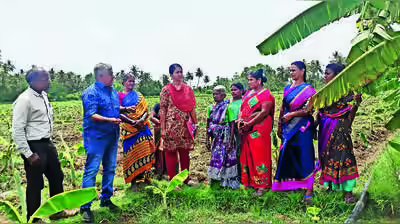
The delayed opening of the Mettur dam is forcing Trichy’s banana farmers to rethink how much they can plant this year. And as an El Niño-induced drought worsens the crisis, farmers are being advised to reduce acreage and adopt water-saving smart farming techniques to minimise losses.The Union agriculture ministry has asked states to draw up district and crop-specific contingency plans for the drought period, with Trichy identified as one of Tamil Nadu’s most vulnerable districts.Cauvery water has not yet been released from the Mettur dam due to low storage levels in the Stanley reservoir. The state govt has attributed the poor inflow to deficient southwest monsoon rainfall caused by El Niño.With Cauvery water yet to be released and water availability drastically reduced, the area under banana cultivation in the district has fallen to 4,300 hectares, 27% below normal levels.“We need Cauvery water for irrigation. Planting without certainty of water will lead to losses,” says ‘Vayalur’ S Rajendran, a farmer from Srirangam.The National Research Centre for Banana (NRCB) has also begun issuing El Niño advisories to farmers through village outreach programmes. “Banana varieties need about 65 lakh litres (6,500 cubic metres) of water per acre annually. Farmers need to reduce their cultivation area,” says R Selvarajan, NRCB director. “We are also encouraging adoption of water-saving technologies such as drip irrigation and fertigation (injecting water-soluble fertilizers directly into an irrigation system), which deliver water and nutrients directly to the plant roots.”Through smart farming, technology can optimize irrigation, says I Ravi, NRCB principal scientist. “It also reduces the need for monitoring by farmers. Watering, for instance, can be avoided when there is rainfall.”Researchers are also promoting practices such as mulching — covering the soil with organic materials — and stem recycling, which involves ploughing back banana stems after harvest. “These help conserve soil moisture and improve soil nutrients. It reduces the need for nutrients such as nitrogen, phosphorus and potassium,” says C Karpagam, principal scientist.The horticulture department is also sensitizing farmers to cultivate bananas with less water, says S Saranya, deputy director in Trichy.BOXCrop crunch• Normal cultivation area: 6,000 hectares• Current cultivation area: 4,300 hectares, down 27%• 95% of the crop depends on Cauvery water supplied through canal systems• Banana is grown as an annual crop, with planting carried out in phases throughout the year