









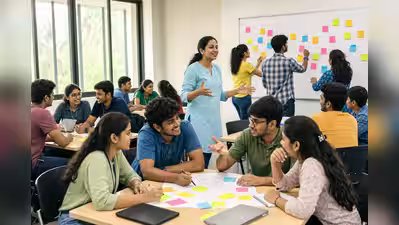
Chennai: To retain the attention of Gen Z students, colleges are reimagining the classroom. The novel ideas include splitting the traditional 50-minute lecture into active and passive learning sessions, creating short videos, quizzes, guided problem-solving sessions and structured discussions.Colleges are taking inputs from alumni and conducting academic audits to make lessons more relevant to students who have grown up with digital devices and have shorter attention span.Rajalakshmi Engineering College has split the class hour into two sessions — active learning and passive learning.“The 25-minute active learning session keeps the Gen Z students engaged in the classroom. Faculty members will begin with examples; students will discuss them among themselves, and there will be a quiz at the end. For the remaining 25 minutes, the students will learn in the traditional way,” said Abhay Meganathan, vice-chairman of Rajalakshmi Group of Institutions.To keep video modules interactive and better explain concepts, the college has introduced an AI mascot, Aadhi, a blackbuck. “We have prepared learning modules based on ‘kutti concepts’ (smaller concepts) to attract youngsters,” he added.On a pilot basis, Anna University introduced an active learning method (ALM) for a theory subject for fifth and seventh semester students at Madras Institute of Technology (MIT) campus.Faculty members prepare concept notes and give handouts to students before the class. Students will receive a brief introduction and be given 15 minutes to read and clarify doubts. They will do mind mapping and write a summary in class.“Many students sit disinterestedly during the traditional lectures, and we keep urging them to stay attentive. The activity-based learning method helps to this end. I am confident all the students in the class will clear the entrepreneurship paper in the recent second assessment test,” said Pavithra, a faculty member from MIT.Anna University registrar (in charge) V Kumaresan said the institution will expand this method to other courses and colleges, including constituent and affiliated colleges based on the pilot study results.Tamil Nadu State Council for Higher Education (TANSCHE) has trained college faculty members on active learning method.Some campuses such as VIT Chennai are planning to make short video lectures to suit the attention span of Gen Z. “We have advised our faculty members to develop lecture videos lasting 5-10 minutes. If the students are further interested, they can watch a full video on the topic,” said G V Selvam, vice-president of VIT Chennai.VIT is planning to redesign the classroom structure into a semicircle to help professors see all the students. “Such classrooms are more suitable for group discussions and case study discussions,” he added.Colleges such as Stella Maris College are planning to include more classroom activities based on alumni feedback. “Students wanted more activities in the classroom. So, we plan to make 40% of class hours activity-based in the upcoming syllabus revision,” said Stella Mary, principal of the college.Some institutes want to initiate project-based learning. “We make our students work on live industry problems. We award credits for it and it is included as part of their assessment too,” said Vikas Mishra, vice-chancellor of Hindustan Institute of Technology and Science.