









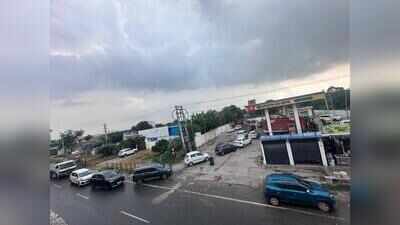
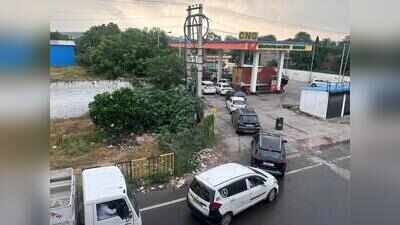
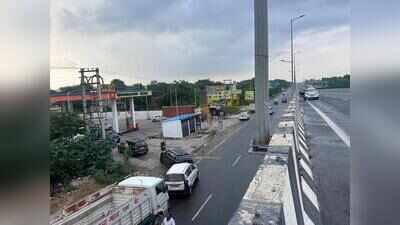
Gurgaon: Delhi-Mumbai Expressway’s promise of an under-three-hour drive to Jaipur is being marred by a major CNG bottleneck that has been gradually emerging on it and is showing up in long wait times for vehicles at gas stations.During the last Rakshabandhan weekend, a Delhi resident who travelled to Pink City with his parents said he waited in their rented Ertiga SUV for an hour and 45 minutes in a queue of nearly 50 cars at a gas station in Alwar, which had just two filling points for CNG. A ride that began from east Delhi at 5pm was completed in around seven hours. He reached Jaipur around midnight.While Rakshabandhan saw a surge in intercity traffic, queuing up for CNG is inevitable on the highway, with an average wait time of half an hour. Queues tend to be longer at Sohna, which is closest to the city and sees cars stop for a refill before making the dash to Jaipur.When these correspondents visited this week, the IGL station in Sohna had a drum placed to separate queues for trucks and cars. Despite eight CNG filling points in operation, cars continued to queue up, with vehicles spilling out of the station and lining the service road as private cars, intercity cabs and commercial vehicles waited their turn. A private car that entered the CNG station at 4.55pm took until 5.18pm (23 minutes) to reach the dispensing nozzle. The refill took just two minutes, and the car exited the pump at 5.20pm.“Spending half an hour at a pump for a process that takes less than two minutes is the best-case scenario during off-peak hours. During peak travel times or weekend rushes, the wait easily stretches to an hour or more. You spend more time waiting for fuel than enjoying the drive on the highway,” said Manoj Singh, a cab driver who was also in the queue for over 20 minutes.For intercity cab operators — like those driving for platforms like Ola, Uber and other outstation ride services like Savaari — the wait is more than an inconvenience. It disrupts schedules and cuts into earnings.“Passengers book cabs expecting a fast trip. When we have to pull over and sit in a CNG line for that long, passengers get restless, and our day’s schedule gets completely thrown off track. Both sides of the highway face the same issue,” said Raman Kumar, an intercity cab driver who frequently shuttles between Delhi and Rajasthan.While the expressway has transformed the drive to Jaipur, CNG infrastructure has simply not kept pace. There are only four CNG facilities currently operational on the Gurgaon-Jaipur section, and only two — both in Pinan, Alwar — have pipeline connectivity. At Sohna and Ferozpur Jhirka, CNG is supplied through mobile cascades (gas cylinders mounted on vehicles), which deliver lower pressure and take longer to refuel vehicles than a pipeline connection does.According to National Highway Logistics Management Limited (NHLML), two additional CNG facilities each are planned at Sohna, Seetal and Rajgarh, and two more on the Bandikui-Jaipur spur, taking the total across this section to 12. Land for these wayside amenities has already been acquired, and tendering for the Bandikui-Jaipur spur is under way, sources said. The new stations are expected to be operational within the next few months. Pipeline connectivity is also being developed for two facilities at Ferozpur Jhirka in Nuh, wherever technically feasible, they added.A senior NHLML official said, “The CNG facilities on Delhi-Mumbai Expressway are being expanded based on traffic demand and fuel consumption patterns. Stations connected to a pipeline are able to refuel vehicles faster. The expansion is being undertaken after assessing actual traffic movement and CNG demand on the expressway. When the Delhi-Mumbai Expressway was initially developed, there was limited data on how traffic would distribute across the new corridor. Now that traffic patterns and consumption are clearer, the requirement for additional CNG infrastructure has emerged. The pipeline infrastructure is primarily being developed by the concerned state govt and gas companies based on demand. Once a pipeline is laid, it can reduce dependence on gas transported through cascades and improve the efficiency of CNG supply.”(With inputs from Akanksha Gupta)