







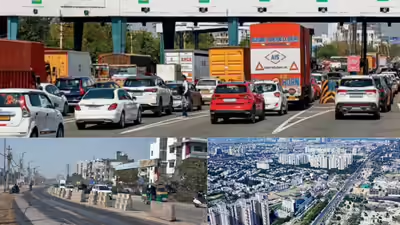
GURGAON: The city continues to lag where it matters most — its roads. Projects meant to ease congestion have been in the works for years, mired in paperwork, indecision, and coordination gaps. Little has changed on the ground for commuters, all this in a city that drives Haryana’s growth. “Gurgaon may be driving the state’s economy, but its infrastructure is not being treated with the same urgency,” said Praveen Malik, president of United New Gurgaon Association. A 2.2km stretch between Hero Honda Chowk on NH8 and Umang Bhardwaj Chowk is a case in point. Nearly a decade on, there is still no final blueprint.
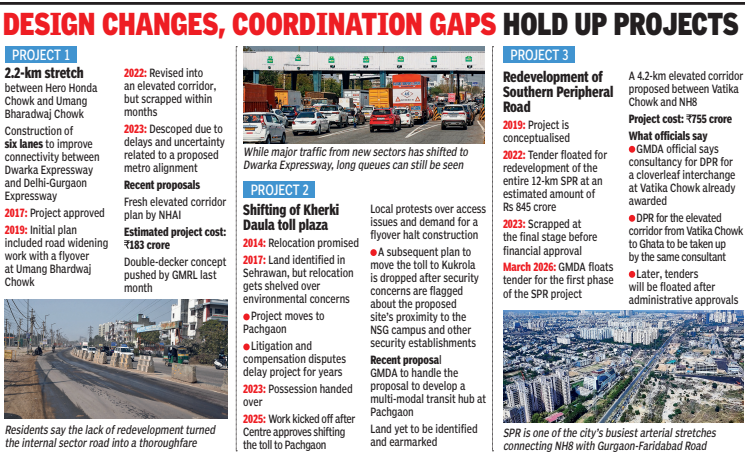
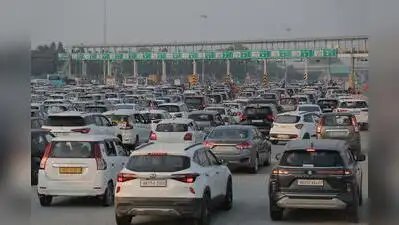
Approved in 2017 for sixlaning — to improve connectivity between Dwarka Expressway and Delhi-Gurgaon Expressway and ease pressure on NH8 — the project has since cycled through repeated design changes without ever reaching execution. What began as simple road widening with a flyover in 2019 was revised into an elevated corridor in 2022, only to be scrapped within months. In 2023, the project was descoped due to uncertainty around a proposed metro alignment. Since then, proposals have swung repeatedly between surfacelevel widening and an elevated road. This year, National Highways Authority of India (NHAI) submitted a fresh elevated corridor plan estimated at Rs 183 crore. A double-decker concept pushed by GMRL last month has also since been dropped. “For such a small stretch, spending years just deciding the design shows the level of indecisiveness. Commuters and residents are the ones paying the price every day,” said Udaybir Singh Yadav, a resident of Sector 10A. The project is being executed by NHAI as a deposit work for GMDA, but approvals and inter-agency coordination continue to crawl. “We have submitted the proposal of elevated road with GMDA, but the decision has been pending at their end,” an NHAI official said. The delay in shifting Kherki Daula toll plaza tells a similar story. The relocation was first promised in 2014 when Union minister Nitin Gadkari and others were caught in a jam at the site. Since then, the project has drifted from one location to another without resolution. In 2017, land was identified at Sehrawan, but environmental concerns stalled progress. The project then moved to Pachgaon, where litigation and compensation disputes dragged on for years. Even after land was handed over in 2023, execution never began. In 2025, the Centre approved the Pachgaon shift and work was initiated, but local protests over access and demands for a flyover halted construction again. A subsequent plan to relocate to Kukrola was dropped after security concerns were flagged by the military. The proposal has since reverted to Pachgaon, where a multi-modal transit hub is now being planned. “As far as NHAI is concerned, no work has been undertaken by us at this stage regarding the toll plaza shift,” an official confirmed, adding that clarity on land handover is still awaited. Meanwhile, the toll remains a daily choke point, particularly for commuters from sectors 77 to 80 and industries in IMT Manesar. Though traffic from newer sectors has largely shifted to Dwarka Expressway, queues persist for those on older routes. “Beyond the financial burden, the toll has become a psychological barrier, restricting movement within the city. There is a clear lack of intent at both the bureaucratic and political levels. Until this is resolved, both daily commuting and industrial activity will continue to suffer,” said Malik. The situation on Southern Peripheral Road (SPR), one of the city’s busiest arterial stretches connecting NH8 with Gurgaon-Faridabad Road, is similar too. GMDA floated a tender last month for the first phase: a 4.2-km elevated corridor between Vatika Chowk and NH8, estimated at Rs 755 crore. However, a similar process was done before — in 2022, a tender for the 12-km SPR, estimated at Rs 845 crore, was floated and scrapped at the final stage before financial approval in 2023. A senior GMDA official said work on subsequent phases is also being processed. “Consultancy for a DPR for a cloverleaf interchange at Vatika Chowk has been awarded and is expected within three months. A DPR for the elevated corridor from Vatika Chowk to Ghata will follow, after which tenders will be floated after administrative approvals,” the official said. Experts said delays of this nature are symptomatic of deeper structural issues. “Projects like these don’t get stuck due to a lack of ideas, but because decisions are not taken in time and planning remains fragmented across political and bureaucratic levels. Designs keep changing, new options are introduced and the process reverts to evaluation instead of execution. With multiple agencies involved, coordination becomes a challenge and accountability gets diluted,” said transport planner and former School of Planning and Architecture professor PK Sarkar. He argues that dedicated technical committees at the city or district level — comprising domain experts empowered to evaluate proposals independently — could help break the cycle. “Technical evaluation must remain the foundation of mobility planning. Without that, even well-intentioned projects can take years to materialise or fail to deliver expected outcomes,” he added