








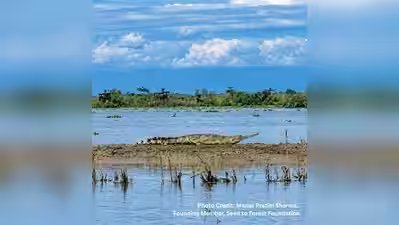
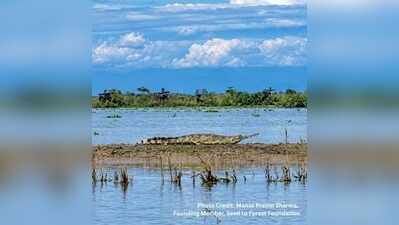
Dibrugarh: A rare sighting of a critically endangered gharial in Assam’s Tinsukia district has renewed focus on the ecological importance of the Lohit-Brahmaputra river landscape and the need for regular monitoring of the species in the region.The gharial (Gavialis gangeticus) was photographed basking on a sandbar near the confluence of Lohit and Brahmaputra rivers on Sept 25 during a biodiversity survey conducted by Seed to Forest Foundation and Balipara Foundation, with participation from local community members.The survey was led by Manas Pratim Sharma and Sandip Chetri. The sighting is significant because it was recorded outside a designated protected area and represents a recent record of the species from the Lohit river system.Gautam Baruah, chief operating architect of Balipara Foundation, said biodiversity monitoring beyond protected areas was important for understanding the movement and survival of threatened species.“Such sightings show that valuable wildlife habitats extend well beyond protected areas. Community participation can play an important role in identifying and monitoring rare species in these landscapes,” Baruah said.Manas Pratim Sharma, a founding member of Seed to Forest Foundation, said the latest record warranted more systematic surveys along Lohit and Brahmaputra.“This sighting is encouraging, but it also raises important questions about the present distribution and habitat conditions of gharials in the Brahmaputra basin. Regular surveys are needed to establish whether this is an isolated occurrence or part of a wider population,” Sharma said.The gharial is a specialised freshwater crocodilian known for its exceptionally long, narrow snout. Once widely distributed across major river systems of the Indian subcontinent, its numbers have declined sharply because of habitat alteration, sand mining, dam construction, fishing-related threats, poaching and disturbance of breeding and nesting areas.The species is listed under Schedule I of the Wildlife (Protection) Act, 1972, and is classified as critically endangered.Historically, gharials have been reported from Brahmaputra and Barak river systems, although confirmed recent records have been limited. A gharial was sighted upstream near Dibru-Saikhowa National Park in Nov 2022, while another was recorded at Kaziranga National Park in May this year.Conservationists said the latest Tinsukia sighting could help guide future studies on the species in eastern Assam. Detailed surveys could establish the gharial’s distribution, possible movement corridors, availability of suitable sandbanks and potential breeding habitats along the Lohit-Brahmaputra system.