








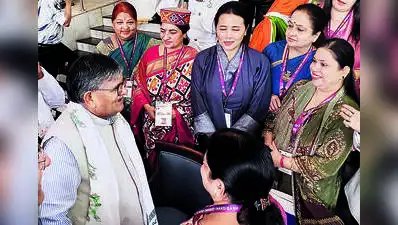
Chandigarh: A uniform five-year tenure for mayors, backed by enhanced administrative and financial powers, emerged as the key demand at the 118th All India Mayors’ Council Conference held in Chandigarh on Monday.At the inaugural session, attended by around 30 mayors from across the country, members unanimously resolved to urge the Union govt to introduce the necessary legal and legislative changes to ensure a uniform five-year term for mayors nationwide.Speaking at the conference, office-bearers of the All India Mayors’ Council argued that a longer tenure would enable more effective implementation of civic projects and improve accountability. They noted that mayors and municipal corporations remain at the forefront of addressing citizens’ day-to-day concerns and therefore require both continuity and adequate authority to deliver.Punjab governor and Chandigarh administrator Gulab Chand Kataria endorsed the demand, stating that Chandigarh’s proposal to increase the mayor’s tenure has already been forwarded to the Centre for consideration.Naveen Jain, Rajya Sabha member and regional head of the All India Mayors’ Council, strongly advocated a uniform five-year tenure, along with clearly defined and consistent roles, responsibilities and powers for mayors across the country. He stressed that the provisions of the 74th Constitutional Amendment should be implemented in both letter and spirit to strengthen urban local bodies and empower mayors as a key pillar of urban governance.Renu Bala Gupta, chairperson of the All India Mayors’ Council, said the conference deliberations focused on strengthening the institution of the mayor through enhanced powers, responsibilities and a uniform tenure. While acknowledging that municipalities function under varied geographical and administrative conditions, she argued for greater uniformity in the tenure, powers, responsibilities and selection process of mayors across India.Ashutosh Varshney, general secretary of the council, also called for extending mayors’ tenures and providing pensionary benefits on the lines of MPs and MLAs, in recognition of their contribution to urban governance.Chandigarh mayor Saurabh Joshi highlighted the wide disparities in the tenure, powers and selection process of mayors across states. He pointed out that mayoral tenures currently range from one year and two years to two-and-a-half years and five years. He also noted that while mayors are directly elected by citizens in some states, they are elected by councillors in others. Greater uniformity, he said, would strengthen urban local governance and help city administrations respond more effectively to growing civic challenges.Box‘One-year tenure too short to understand system’Recalling the council’s long-standing demand, Kataria said a one-year mayoral term is too short for an elected representative to fully understand the functioning of the civic body and leave a meaningful impact.Speaking to mediapersons, Kataria said Chandigarh’s proposal to increase the mayor’s tenure from the existing one year to two-and-a-half years has already been sent to the Ministry of Home Affairs for approval.At the same time, he cautioned that a five-year tenure can also pose challenges. Citing examples, he said situations may arise where the mayor belongs to one political party while the majority of councillors belong to another, leading to administrative deadlock and slowing development works. Such factors, he said, must also be taken into account while considering reforms.Kataria added that mayors should remain closely connected with citizens, listen to their concerns and work for their welfare. He also stressed that humanitarian considerations should complement legal and regulatory provisions while dealing with violations and civic issues.