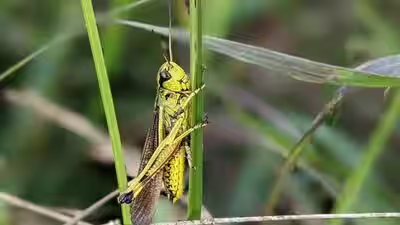








A dose of insecticide killed 97.91% of mosquitoes that spread dengue; a tiny fraction that survived has researchers in Delhi worried

While India is a country filled with annual cultural traditions, a natural one that returns every year without fail is the buzzing around the bed as soon as the monsoon rains begin pelting the ground. Most of the mosquitoes that entered homes and offices were removed with the help of α-cypermethrin, a widely used pyrethroid…

Read More

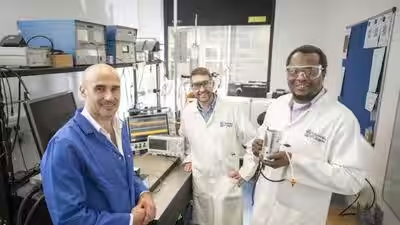
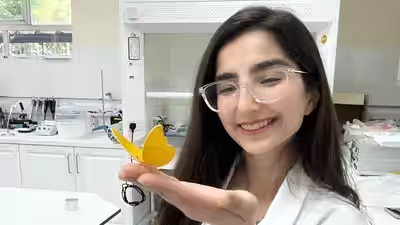
Butterfly wings inspire a breakthrough solar panel design that could boost electricity production by 66% |

Ornithoptera priamus. Image Credit: Robert Nash/Curator of Entomology Ulster Museum/Wikipedia Butterfly wings could offer a unique solution to one of the biggest problems faced by solar panels, which is ‘sunlight that bounces away before it can be used.’ A study published in ‘Solar Energy’ explored how the tiny structures found on the black scales of…

Read More

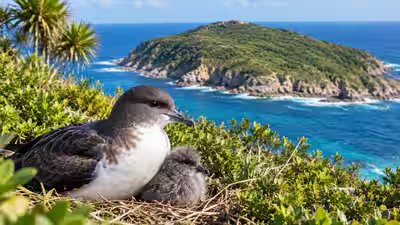
In 1935, black drongos were introduced on Rota to control crop pests; decades later the aggressive birds spread to Guam and became a threat to native birds

A juvenile and an adult Black Drongo perch on a tree branch (ANI Photo) In 1935, the Japanese South Seas Development Company made a decision that would have repercussions for Mariana Islands’ ecosystems for nearly 100 years. In search of a natural method for controlling agricultural pests, they imported black drongos (Dicrurus macrocercus) from Taiwan…

Read More

Lake Maracaibo in Venezuela is a natural light show that appears on hundreds of nights every year, making it one of the world’s biggest lightning hotpots |

Catatumbo lightning at night. Image Credit: Fernando Flores/Wikipedia Lake Maracaibo in north-western Venezuela is home to one of the most remarkable lightning displays on Earth. Around the southern part of the lake, thunderstorms can return night after night, producing flashes with such regularity that the phenomenon is known as ‘Catatumbo Lightning’ (because Catatumbo River meets…

Read More

In 2026, scientists found oak trees can delay spring leaf growth by three days to starve hungry caterpillars |

​Representative Image of oak trees with delayed budburst as caterpillars wait for young leaves to emerge (AI-generated image) In temperate forests, spring timing can determine whether newly hatched caterpillars find a feast or almost nothing to eat. Many herbivorous insects emerge around the time trees produce their first young leaves, when the foliage is soft…

Read More

Meet Max Hung Nguyen, the 17-year-old California student who used Nasa data and AI to predict which stars are most likely to have giant planets |

Max Hung Nguyen was 17 when he began looking at a problem that astronomers have been studying for decades: whether the chemical make-up of a star can offer clues about the planets that form around it. The Leland High School student from San Jose used data from Nasa’s Exoplanet Archive and the Hypatia Catalogue for…

Read More

Meet Kiefer Chow and Amelia Chow: The California siblings who are copying beavers to build dams that restore habitats and reduce wildfire risk |

Growing up along Adobe Creek in Mountain View, Kiefer Chow spent his childhood afternoons doing something most people would call child’s play: stacking sticks and mud into makeshift dams. Years later, that same instinct would grow into something far more consequential. Alongside his sister Amelia, Kiefer founded Eco-Engineering In Action, a youth-led non-profit built on…

Read More

Scientists discover how ancient Chinese paintings used blood to survive for 2,000 Years |

Detail of the main Huashan Rock art. Image Credit: Rolfmueller/Wikipedia Ancient paintings covering limestone cliffs in southern China may owe their remarkable survival to an unexpected ingredient known as ‘blood.’ A new study of the ‘Huashan rock art’ in Guangxi published in the ‘Journal of Archaeological Science’ suggests that the artists used a mixture containing…

Read More

Meet Rohan Naidu, the MIT astronomer who left engineering at 18; now he is helping uncover how the Universe’s earliest black holes formed

Image(s): Left/Department of Physics, MIT/Right/MoM-BH*-1 A Hyderabad-born astronomer who left engineering school at 18 and counts Test cricket among his favourite pastimes is now helping scientists look deeper into the earliest chapters of the Universe. Rohan P. Naidu, an MIT Pappalardo Fellow in Physics, is the lead author of a new Nature study that examines…

Read More