








Quote of the day by “The Chinese Marie Curie” Chien-Shiung Wu: “There is only one thing worse than coming home from the lab to a sink full of dirty…” |

Chien-Shiung Wu (Image: Wikipedia) This quote from Chien-Shiung Wu has been floating around science circles for years, sometimes posted with a bit of humour, sometimes with admiration, and sometimes just as a passing thought people save without really explaining why. On the surface, it sounds light, almost domestic in a way, like someone complaining about…

Read More

Quote of the day by Marie Curie: “Nothing in life is to be feared, it is only to be understood. Now is the time to understand more, so that we may fear less.” |

Marie Curie (Image: Wikipedia) There are certain quotations that survive decades because they speak not only to the moment in which they were said but also to experiences that continue to repeat in human lives. Marie Curie’s words belong to that category. The quote does not sound dramatic at first reading. It does not contain…

Read More

Meet China’s new humanoid robot: It can cook dinner, wash clothes and care for seniors, but one everyday problem still stops it |

China’s race to build practical humanoid robots has mostly played out behind factory doors so far. Machines have sorted parcels, carried components, and repeated carefully programmed movements in controlled environments. But a different challenge is beginning to emerge, one that appears far messier and far more personal. As reported by the South China Morning Post,…

Read More

NASA is using AI to predict harmful algae blooms before they become environmental disasters |

The issue of harmful algae blooms is currently becoming one of the major environmental and health risks in the world, impacting lakes, rivers, reservoirs, and even coastal areas on various continents. To tackle this problem, the NASA agency has decided to apply technologies of artificial intelligence, machine learning, and remote sensing to detect harmful algae…

Read More

Stanford scientists cured Type 1 diabetes in a breakthrough experiment |

Researchers at Stanford Medicine have reported a breakthrough in Type 1 diabetes research after successfully curing the disease in mice using a new method designed to “reset” the immune system. The experimental treatment combined stem-cell transplants, insulin-producing pancreatic cell transplants and a much gentler preparation process involving low-dose radiation and immune-targeting drugs. After treatment, the…

Read More

Brazil races to lab-grow donkey collagen as China’s chase for youth pushes species toward collapse

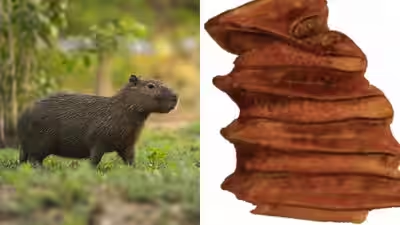
Brazil is developing lab-grown donkey collagen to counter a global decline in donkey populations driven by rising demand for China’s traditional anti-ageing medicine, ejiao. Through the effort, scientists are aiming to deliver a scalable alternative by 2027 that could reduce slaughter and stabilise the species.At the centre of this effort is Carla Molento, a veterinarian…

Read More

Massive gravity “hole” beneath the Indian Ocean finally gets a possible explanation after decades of scientific mystery |

For decades, a vast region south of India has quietly refused to make sense. Satellites mapping Earth’s shape kept returning the same unsettling result: the ocean surface there sits noticeably lower than it should, as if something invisible is pulling it down from below. Ships passing through would never notice anything unusual, yet space-based measurements…

Read More

What began as a bizarre 1959 metal experiment could end up changing how the world reuses heat and generates electricity |

Inside factories, data centres and power plants, heat is usually treated as a problem rather than a resource. It drifts away in plumes, warms the surrounding air, and disappears into the atmosphere with little thought given to its potential. Yet some engineers are now circling back to that wasted energy and asking a slightly unusual…

Read More