








Nasa-backed SPARK project could send tiny ‘aerobots’ into caves on Saturn’s moon Titan |

Nasa-backed SPARK project could send tiny ‘aerobots’ into caves on Saturn’s moon Titan( PC: AI Generated) Nasa has backed a new concept that could send small flying robots into caves on Saturn’s moon Titan. The project, called SPARK, proposes lightweight vehicles known as aerobots that could be released by a larger spacecraft and guided through…

Read More

Hawaii’s native stilt nearly disappeared decades ago; communities and scientists helped its population surpass 1,500 after decades of conservation efforts |

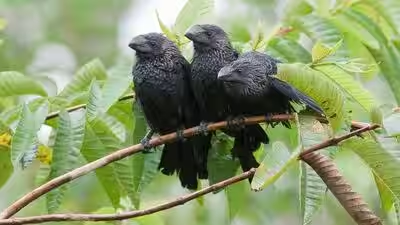
Hawaii’s native Hawaiian stilt, known as aeʻo, has made a remarkable recovery after decades of population decline pushed the bird to roughly 200 individuals in the 1940s. Habitat loss, hunting and introduced predators had severely affected the long-legged wetland bird. More than five decades of legal protection, wetland restoration, predator control and monitoring have since…

Read More

Meet Alfred Drummond-Herdman: The 27-year-old trainee lawyer who fills his bedroom with animal dung to film fungi and has identified two new species |

Alfred Drummond-Herdman, a 27-year-old trainee lawyer in Edinburgh, has turned his bedroom into an unusual fungal observation space, filling terrariums and plastic containers with cowpats, grouse droppings and rabbit pellets to document the fungi that grow on them. His fascination with dung-dwelling fungi began during the pandemic after he encountered cowpats covered with mushrooms in…

Read More

Smithsonian researchers used X-rays, plastic cups and 216-yard spools of thread to find wild turtle nests; predators raided 13 of 16

Eastern box turtle (Image Credit: Canva) Finding a turtle nest in the wild is far more difficult than it sounds. Smithsonian researchers studying Eastern box turtles in Virginia have been using a combination of technology and surprisingly simple tools to locate nests and understand what happens to the eggs after they are laid. Their unusual…

Read More

Would you eat ketchup that was made from algae but fulfilled your protein intake? Scientists have just created one and they want to see how much algae flavour people will tolerate

Just like everything else in the world, even food is coming to have its own trends. From a Mediterranean diet to a protein-rich diet, people are trying everything on the internet to be able to achieve their “ideal” body. Recently, scientists used a “gene gun” to shoot pig DNA into produce to create a protein-packed…

Read More

A rare Australian plant last recorded in 1967 has been found alive in remote Queensland after nearly six decades

A rare Australian plant last recorded in 1967 has been found alive in remote Queensland after nearly six decades (Image: AI Generated) A small Australian shrub that had effectively disappeared from the scientific record for nearly six decades has been found alive in a remote part of northern Queensland. Ptilotus senarius, a species known from…

Read More

University of Texas researchers turn everyday biomass into a machine that makes water from air

What if food scraps, discarded branches and seashells could help produce drinking water from the air? Researchers at the University of Texas at Austin have developed a new class of biomass-based hydrogels that can capture atmospheric moisture and release it as clean water using relatively mild heat. The approach, described in the peer-reviewed journal Advanced…

Read More

Only nine such butterflies were found in US in 2022; 3 years later, over 1,300 were released

Researchers in Michigan have helped bring the Poweshiek skipperling butterfly back from the brink of extinction after its US wild population fell to just nine in 2022. Through captive breeding, habitat restoration and carefully planned releases, more than 1,300 butterflies were released in 2025. The recovery effort has now expanded to other endangered butterflies, while…

Read More

Too early to tell where India fits in

Nasa just invited India to help build a permanent base on the Moon. It’s the kind of headline that writes itself — and yet, what it actually means for India is still almost entirely undecided.Nasa wants to do something considerably more ambitious than return astronauts to the Moon. It wants to start building a place…

Read More

San Diego’s Leanne Fan, 18, built a device to simulate microgravity and tested red light on injured flatworms; tissue regeneration sped up by 95.2%, helping her win $80,000

Fan built her own $200 device instead of using NASA’s $50,000 clinostat. (Society for science photo) Leanne Fan, an 18-year-old student from San Diego, has been named a finalist in the 2026 Regeneron Science Talent Search for her research into wound healing in space. Her project looks at whether red light therapy can help wounds…

Read More