





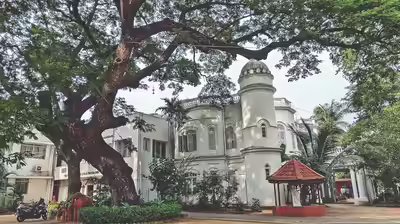
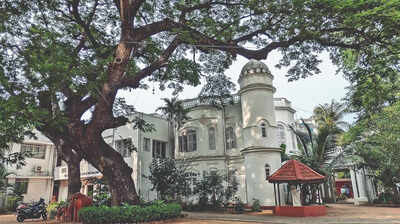
A 200-year-old bungalow, which had the first flush toilets in Madras, on a sprawling green campus bang in the midst of Alwarpet with ancient trees and Indie dogs lazing around, well-stocked libraries open to the public, with a book of poems signed by William Wordsworth – C P Ramaswami Aiyar Foundation at Eldams road, which turns 60 this year, is full of surprises.Each of the many centres at the foundation originated organically. The year was 1985, and a young lady walked into the centre, asking Nandita Krishna, the foundation’s director, for space to “teach children with learning difficulties”. In the 1980s, learning difficulties were unheard of, but Nandita offered her a room upstairs at the foundation with basic furniture. The room later evolved into the Saraswati Kendra, one of the country’s first schools for children with learning disabilities. The centre has 120 students today, many of whom are later moved to the regular school on campus – Grove School, which, Nandita says, was originally a school for the siblings of the Saraswathi Kendra children, who were given first preference in admission.Ironically, though it was C R Pattabhi Raman, eldest son of CPR and former advocate and minister of law, govt of India, who donated their family home to the foundation, it was a group of citizens including senior lawyers and dancer Rukmini Devi Arundale who founded the institution in the name of the politician and administrator. In the first year, the foundation ran from a building in Mount Road, and only lectures on religion and philosophy were held there, says Nandita Krishna, also the great-granddaughter of CPR.“In 1974, I came down to Chennai from Bombay and wanted to start an art gallery here. My grandmother suggested I start it at the foundation. There were no galleries for craft at that point, and so I started CP Art Centre with craft bazaars,” she says. Coming up at the centre is a series of exhibitions of ancient utensils, textiles and dolls from Kanchipuram, where the foundation has a branch.Nandita was also on the lookout for a job as a research officer in history, having studied ancient Indian culture at Bombay University, but again found none, which led to the founding of the C P Ramaswamy Aiyer Institute of Indological Research in 1978. The centre’s library has a collection of rare books and palm-leaf manuscripts, as well as reference books on Indian philosophy, religion, etc. Affiliated with Madras University for PhD degrees in history and environmental science, it now has eight doctoral students. Meanwhile, as part of the Saraswathi Kendra, they launched programmes to train school principals and later primary school teachers on learning disabilities in children. “That’s the age the symptoms first appear,” says Nandita.In 1989, Nandita started the CPR Environmental Education Centre, inspired by then minister T N Seshan, with a friend Shamim Padamsee. “Over the years, the centre has restored 53 sacred groves, spread across villages in the state. Right now, we are in the process of documenting the ecological traditions of different states in the country,” says Nandita. The foundation also worked to revive folk art forms in schools in Tamil Nadu, as part of which they trained teachers and worked with children on performing folk songs and music.The children at the two schools are regularly taken to the Blue Cross of India, where they volunteer to help animals. “We have Indie dogs on the campus, and the children in the regular school grow up interacting with special children. The most wonderful thing we have achieved is that over the years we have produced compassionate children who grew up into adults compassionate towards animals and human beings.” —–The Dr Dog programme at Saraswathi Kendra helps children with special needs with pet therapy, allowing them to interact with dogs approved for the process. “A child who had never spoken a word once spoke to the puppy –‘I had upma today, what did you have?’ to the surprise of the parents and the teachers,” says Nandita.• There was a time when the premises were so wooded that jackals, civet cats and even an occasional leopard could be spotted• Parts of the building have Italian floor tiles and a false roof brought in from Belgium• The house originally belonged to a British lawyer, John Bruce Norton, who served as the advocate-general of Madras from 1863 to 1872. His son, Eardley John Norton, called the ‘Lion of the Madras Bar’, was a towering figure in trial advocacy, a founder of the Indian National Congress and a champion of civil liberties. He practiced at Madras high court from 1879 to 1907 before moving to Calcutta, notably serving as a prosecutor in the famous Alipore Bomb Case