








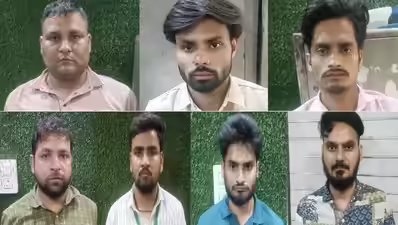
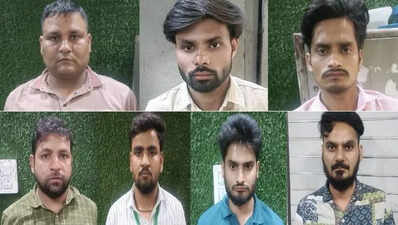
Noida: As NEET, India’s main medical entrance exam, finds itself in choppy waters after a paper leak, yet another exam fraud has come to light, this time in UP.The special task force (STF) has arrested seven members of an organised racket involved in sophisticated manipulation of the Staff Selection Commission (SSC) online recruitment examinations. The accused were allegedly helping candidates clear competitive exams by giving answer writers remote access to candidates’ screens.The arrests were made after the Noida unit of STF raided Balaji Digital Zone Centre in Knowledge Park on Friday evening. Officials said the gang was involved in rigging the SSC examination for constable (General Duty) posts in Central Armed Police Forces (CAPF) and Secretariat Security Force (SSF), as well as the Assam Rifles exam for rifleman recruitment this year.Among those arrested is Pradeep Chauhan, the alleged ringleader of the operation and the IT head of the exam centre. The others were identified as Arun Kumar from Mathura, Sandeep Bhati, Vivek Kumar and Nishant Raghav from Bulandshahr, and Amit Rana and Shakir Malik from Baghpat. Kumar and Malik appeared as candidates in the examination.During the raid, STF recovered Rs 50 lakh in cash, 10 mobile phones, five laptops, a router, a list of candidates, two admit cards and four identity cards of Eduquity, a private company associated with the examination process.Raj Kumar Mishra, additional SP of STF (Noida), said the gang developed a technically advanced system to manipulate online exams. “The accused bypassed the examination centre’s server and installed two proxy servers inside the facility. Many examinations are conducted online through laptops or computers,” he said.The cheating, he explained, was done using remote access tools like UltraViewer and AnyDesk, which were installed on a candidate’s computer through a parallel mechanism set up in advance at the exam centre, something that cannot be done without insider involvement. “The candidate only appears to be taking the exam, while another person sitting far away remotely controls the screen and writes the answers,” Mishra said.Since this does not involve hacking into servers but bypassing them, such tools elude examination software. The exam system appears to function normally while the remote operator secretly accesses and controls the computer.A proxy server acts as an intermediary system that connects computers at examination centres to the main exam server. In case of SSC, for example, it transmits question papers from its central server to various centres, which then download the paper into the local server at a scheduled time.“All computers in the exam lab are connected to that centre’s local server using network switches and Cat-6 cables. The manipulation takes place at this stage. Individuals involved in cheating attached an additional Cat-6 connection to get remote-access software installed on the candidate’s workstation,” Mishra said. “External solvers solve the paper remotely, enabling organised cheating.”Videos of the servers operating through laptops, one placed inside a cabinet in an office and the other hidden in a storeroom at the centre, were seen by this correspondent.Officials said Arun Kumar played a crucial role in setting up the proxy servers inside the examination centre. He earlier worked as an invigilator at the same centre and was later appointed its IT head.“Amit Rana designed the technical framework used for cheating. Sandeep Bhati worked as a recruiter for the gang. Bhati, who previously worked as a lab supervisor in various companies, identified candidates willing to pay money to clear competitive examinations and connected them with the racket,” Mishra said.According to investigators, the gang charged Rs 4 lakh per candidate for ensuring success in the examination. Out of the total amount, around Rs 50,000 was paid as commission to middlemen or agents who referred the candidates.STF officials suspect the gang has helped several candidates secure jobs fraudulently across different exams. They are investigating how many examinations were compromised and whether more people linked to examination centres or private agencies are involved in the operation.A case has been registered at Knowledge Park police station under Sections 111(3) and 111(4) (organised crime), 318(2) (cheating), 61 (criminal conspiracy) of BNS, and Section 66 of the Information Technology Act.“Amit Rana designed the technical framework used for cheating. Sandeep Bhati worked as a recruiter for the gang. Bhati, who previously worked as a lab supervisor in various companies, identified candidates willing to pay money to clear competitive examinations and connected them with the racket,” Mishra said.According to investigators, the gang charged Rs 4 lakh per candidate for ensuring success in the examination. Out of the total amount, around Rs 50,000 was paid as commission to middlemen or agents who referred the candidates.STF officials suspect the gang has helped several candidates secure jobs fraudulently across different exams. They are investigating how many examinations were compromised and whether more people linked to examination centres or private agencies are involved in the operation.A case has been registered at Knowledge Park police station under Sections 111(3) and 111(4) (organised crime), 318(2) (cheating), 61 (criminal conspiracy) of BNS and Section 66 of the Information Technology Act.