









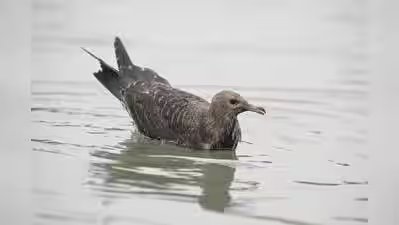
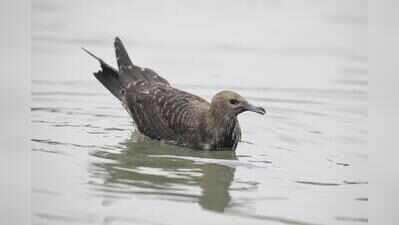
Kolkata: A rare seabird with a rather unusual way of finding food has made its second recorded appearance in Bengal, after an Arctic Skua (Stercorarius parasiticus) was sighted in the Sundarbans on Sunday by several naturalists and tourists.Known locally as ‘Jaladashyu Pakhi’, or the pirate bird, the Arctic Skua gets its colourful name from its distinctive feeding behaviour. Rather than always hunting for its own meal, the bird is known to chase gulls, terns and other seabirds and force them to drop the fish or other food they have caught. The Skua then swoops down and grabs the abandoned catch.Kanad Baidya of Birdwatchers’ Society said though there have been records of the bird from the country’s western coast with occasional sightings from southwest coast, in the eastern coast it’s rare and was clicked last by birder Jayanta Manna at Frasergunj in Oct 2019.Nityananda Choukidar, a naturalist and boatman in the Sundarbans, said he was travelling along the creeks on his boat with tourists on Sunday when he spotted the bird. “Being a naturalist, I have always had a soft corner for birding. When I saw the bird feeding on a fish, I felt that it was something I had not seen in the Sundarbans before. I told my guests to take pictures. Later, it was identified as an Arctic Skua,” he said. Photographer and tour operator Soumyajit Nandy, who also photographed the bird in the Sundarbans on Sunday, said although the Arctic Skua is rare in the region, there have been a few records of pelagic birds from the Sundarbans Tiger Reserve area. “Skuas are occasional passage migrants or storm-blown vagrants during the monsoon and early post-monsoon dispersal in the delta,” he said in a social media post.The bird’s behaviour of stealing food is known as kleptoparasitism — essentially, stealing food caught by another animal. The tactic becomes particularly important for Arctic Skuas during migration and in their wintering grounds, when they spend considerable time at sea.The species is also widely known as the parasitic jaeger. The name ‘jaeger’, derived from the German word for hunter, reflects the bird’s fast, aggressive aerial pursuits, while ‘parasitic’ refers to its habit of obtaining food from other seabirds.The Sundarbans sighting is significant for Bengal’s birding community as it represents only the second documented record of Arctic Skua from Bengal.Arctic Skuas are long-distance migrants. They breed across the northern reaches of the globe, including Fennoscandia, Scotland, Iceland, Greenland, northern Canada, Alaska and Siberia, before undertaking long migrations to wintering areas across the southern hemisphere.