








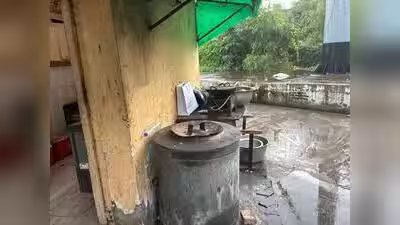
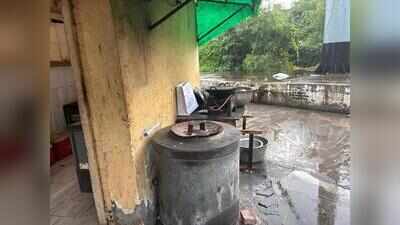
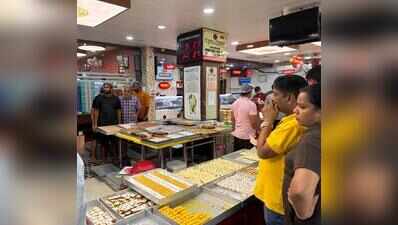
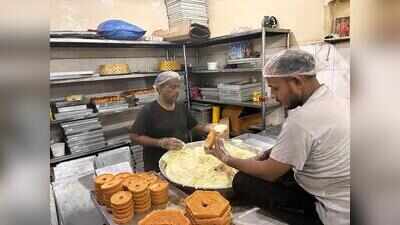
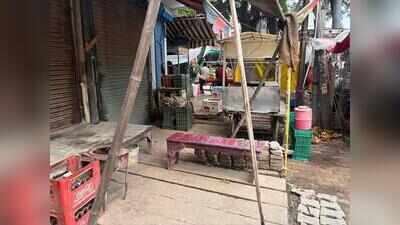
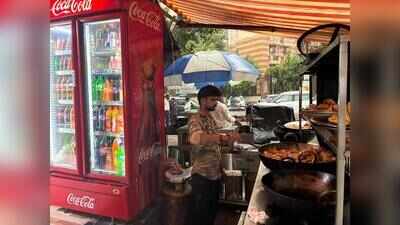
Rows of golden, crisp samosas sit beside trays of ghewar dusted with silver leaf, tandoori chicken and kebabs turning slowly on their skewers. At sweet shops and eateries across NCR, counters offer a kind of theatre, built on colour and aroma and the promise of festivity as the season gets under way.What happens beyond that counter is a different story.On Aug 25, Ghaziabad’s food safety department raided a warehouse in Biharipura and seized 10 quintals of chhena rasgullas suspected of adulteration. Officials alleged the sweets were made with adulterated paneer and sugar, along with chemicals including sefolite, a compound commonly used in textile printing and as an industrial reducing agent, not food. Four samples were sent for laboratory testing. The rest of the stock, taken into custody, was disposed of.Adulteration, officials say, is only part of the problem. What the raids do not capture is the ordinary, unremarkable state of a kitchen on any given afternoon, the kind of thing a customer never sees.In Nehru Nagar, TOI last week found two workers folding samosas in a cramped corner of a sweetmeat shop while ghewar and laddus were spread on a netted tray balanced atop a covered drain, with an iron-welding unit humming a few feet away. The shop’s owner, Jyoti Devi, made no claims to scale. “We keep the area clean as much as we can,” she said. “This is a small village area. My hands are clean and we ask our workers to wash their hands properly before cooking. That is it.” She added, without apology, “We are small units and we do not have that capacity and it does not concern people buying from us. It is taste, and our shop is very old.”In Noida’s Sector 29, a chicken grilling outlet known equally for its jhol momos had soiled work slabs and vegetables stacked loosely in a corner. A worker, Aman, explained the arithmetic of a small operation. “The investment is limited,” he said. “What we earn goes into buying vegetables and items needed to prepare the food and the salaries. The rent of this small shop is also paid by us. You cannot expect a 5-star treatment here.”A few metres on, another kitchen bore the residue of years of cooking, dried spice spatter climbing the tiled walls. Subodh, who works there, described a routine shaped entirely by exhaustion. “It has been like this only,” he said. “It is our daily job, and chopping and cooking take a lot of effort. We have a lot of rush by the evening and then we want to just go back home and sleep. We do not get much time, but clean it once in a while when it gets very dirty.”Scale, it turns out, can buy cleanliness. At a prominent sweet shop in Nehru Nagar, preparations for Teej and Janmashtami were in full swing, with footfall expected to reach 5,000 to 6,000 customers over two days. Its second-generation owner, Sagar Yadav, presided over an operation with hair caps and gloves on the packing staff, a warehouse-like preparation floor upstairs for cutting sweets and dipping them in syrup, and an in-house kitchen with tiled interiors that looked, on the day of the visit, genuinely clean. “We have 40 workers and do whatever is needed to keep the area clean.”In Indirapuram and Vaishali, several shops have simply moved the mess elsewhere, relying on centralised kitchens. One chain owner in Vaishali framed hygiene as a matter of brand survival rather than principle. “We are larger units and slight slack in hygiene can cost us the reputation of the brand,” he said. Yet even there, workers were seen preparing and serving bhatooras without gloves or head caps.Noida tells a similar story. At a Sector 62 outlet, samosas and jalebis are made on-site while other items come from a warehouse in Indirapuram, according to owner Paras Jain. Workers were seen frying and packing bare-handed, pausing to rig a tent against the rain.The law, on paper, is unambiguous. Under Section 56 of the Food Safety and Standards Act, eateries found preparing food in unhygienic or unsanitary conditions face a penalty of up to Rs 1 lakh. If an inspection finds the food itself unsafe, Section 59 allows for imprisonment and steeper fines, calibrated to whether the food causes no injury, non-grievous injury, grievous injury or death. But with thousands of establishments across the two districts, the scale of the task is considerable.Officials describe a system stretched thin. Noida is divided into 10 zones, Ghaziabad into 21, each overseen by a single area in charge responsible for both personal and sanitary hygiene. “It is easier to inspect bigger outlets,” Ghaziabad’s district food supply officer, Suresh Mishra, said. “They understand the process, but for smaller eateries, the enforcement is difficult as the rules are similar for both.”Mishra said inspections run through area officers who upload photographs and details online. “The area officer, currently 19 in the district, visits the shops and uploads the picture on the website,” he said. “During inspection, if they find that hygiene, both personal and sanitary, is missing, a 14-day notice is given. In case the owner does not get it fixed within the timeframe, a revised inspection is conducted and, if the improvement is not made, the licence is cancelled.” He added, “We give them more time for construction-related works.”In Noida, food supply officer Sarvesh Mishra pointed to training rather than punishment as the department’s preferred tool. “We conduct food safety training programmes frequently and ask operators to join and learn,” he said. “We conduct regular inspections and try to go by the rules as much as we can.”For many customers, the calculation is simpler than any regulation. “We come here for fun, but we cannot lose sight of hygiene,” said Abhishek Sharma, a regular at one of the Noida stalls. “As long as we are having good food and not falling sick, it works. But basic cleanliness must be there.”Tanushree, another customer, was less forgiving. Referring to the Aug 21 case in which a customer at PAUL, a French bakery chain’s outlet in Gurgaon, found a live worm inside a sandwich, “If we are paying for the food, we expect that it has been made in sanitary conditions and does not contain harmful and expired ingredients,” she said. “The food safety department should show no mercy to violators.”