









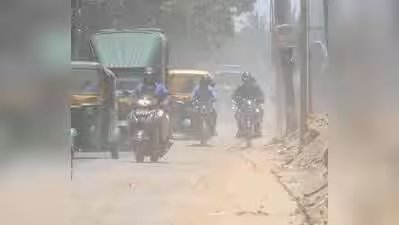
Bengaluru: Greater Bengaluru Authority (GBA) and other local bodies across Karnataka may clean roads, tighten emission norms and curb local pollution, but there is no stopping cross-state air pollution. A recent study has highlighted the movement of pollutants across southern states and stressed that Karnataka’s worsening air quality cannot be tackled within political boundaries, as its cities receive a significant share of pollution from outside the state.The study, by the Centre for Study of Science, Technology and Policy, titled Governance Framework for Airshed-Level Air Quality Management in South India, was released Wednesday at the India Clean Air Summit (ICAS) 2026 in Bengaluru. It called on Karnataka and its neighbouring southern states to adopt an airshed-based approach, under which multiple states jointly address pollution generated and transported across the region.The study found that 47% of Karnataka’s annual average pollution originates within the South Indian region. Of this, 65% comes from sources within Karnataka and 35% from outside the state. Among the five southern states, Karnataka ranks third, after Kerala (65%) and Tamil Nadu (61%), and ahead of Andhra Pradesh (44%) and Telangana (38%).Cross-state pollution accounts for 43% of Karnataka’s pollution during winter (Dec-Feb). Andhra Pradesh is the largest outside contributor, accounting for 15% of the pollution transported into Karnataka. However, the study found that Andhra Pradesh contributes relatively little to pollution levels in the other four southern states.The findings assume significance as Bengaluru continues to grapple with rising pollution from multiple sources, while air quality is also deteriorating in several other parts of Karnataka. The study suggests that city-specific measures may not deliver sustained improvements if pollution generated in neighbouring states continues to reach Karnataka.State’s central locationAccording to the report, Karnataka occupies a crucial position in South India’s pollution network because of its central geographical location. Tamil Nadu and Andhra Pradesh are net contributors, exporting more pollution than they receive, while Kerala and Telangana are net receivers. Karnataka, meanwhile, both receives and exports moderate quantities of pollution.Domestic activities, industries and open burning were identified as the three largest local sources of pollution across the five southern states. Domestic, energy and industrial sources were also identified as major contributors to transported particulate matter (PM2.5).“In South India, the major gap in air quality management is the control of non-local pollution in these cities. The air quality over a particular city or state is not determined solely by sources located within its own boundaries but is also substantially influenced by upwind sources. A region can be upwind (a source of pollution) or downwind (a recipient of pollution) depending on geographical conditions and wind patterns. In South India, where transboundary pollution is substantial and varies by season, air quality action must shift from a city-level to an airshed-level approach,” the report highlighted.Researchers explained that an airshed is a geographic area where pollutants are carried or accumulate, affecting air quality. “These are largely shaped by meteorology and topography rather than actual boundaries extending to several regions,” a researcher clarified.What study suggestsThe study has recommended creating an institution for South India, modelled on the Commission for Air Quality Management, to coordinate air pollution control across Karnataka, Tamil Nadu, Andhra Pradesh, Telangana and Kerala.It has also called for a shift from city-specific projects to airshed-based pollution management. The five states have been recommended to develop a common pollution/emissions inventory to identify pollution sources and quantify the movement of pollutants across state boundaries. A common approved fuel framework and uniform targets for electric-vehicle adoption across the region are also suggested.