









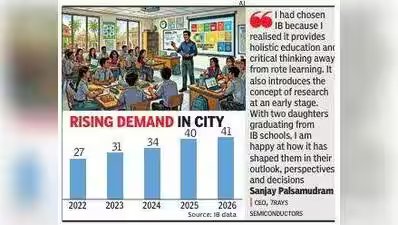
Bengaluru: Bengaluru recorded a 52% increase in the number of International Baccalaureate (IB) World Schools over the past five years, according to IB data. The city currently has 41 IB World Schools, India’s second-largest concentration after Mumbai, reflecting a steady expansion of the network.India has 287 IB schools, up from 204 five years ago. Mumbai has 49, followed by Bengaluru with 41, Hyderabad 30, Chennai 18, Gurugram 16 and Pune 14. Delhi and Noida have 8 each. Beyond the largest metropolitan concentrations, Ahmedabad has 7 IB World Schools, Jaipur 6, and Coimbatore and Kochi 5 each.Demand for IB education is no longer confined to a few major metropolitan markets, said Ashish Trivedi, IB’s head of South Asia and Japan. IB also has a presence in cities including Visakhapatnam and Madurai, with three schools each, as well as Vadodara, Surat, Lucknow, Bhubaneswar, Chandigarh, Kozhikode, Amritsar and Tiruchirappalli.Karnataka’s IB network remains concentrated in Bengaluru, with data showing only one authorised IB World School outside the city – in Mysuru. But Trivedi says this could change as awareness and demand expand.Stating that Bengaluru’s education market has matured, Association of International Schools of India chairperson Syed Sultan Ahmed said: “Bengaluru parents have access to more information, more choices and greater exposure to different models of schooling. That creates an environment where schools experimenting with different curricula and approaches can find an audience.”Ahmed added: “Bengaluru’s global character is another important factor. For many families, having education that’s internationally recognised and allows children to move between different education systems isn’t simply a preference; it’s a practical consideration.”KP Gopalkrishna, founder, The International School Bangalore, one of the first IB schools in the city, said: “When Manmohan Singh, as finance minister, opened up the economy and IT sector boomed, many expats returned. But they couldn’t find a matching school for their children when they returned. So we started a school with world class facilities.”Sarojini Rao, principal, Indus International School, said: “When we started 25 years ago, there was a market for IB schools as IGCSE was the only other international curriculum offered. What attracted parents that time, and mostly even now, is that IB is considered a passport to foreign universities. We’re trying to make parents aware that it’s much more than that. We opted for IB for the flexibility it allows. It permits us to empower students with competencies and innovation so they can charter their future.”Experts said one reason for concentration in Bengaluru is the lack of an ecosystem in rural areas. Sultan said shortages of teachers and school leaders trained to teach differently affected the quality and costs. As more schools adopted international curricula, the main challenge would be ensuring enough well-trained teachers and capable school leaders to deliver the education envisaged by such curricula.Sanjay Palsamudram, CEO, 7Rays Semiconductors, said, “I had chosen IB because I realised it provides holistic education and critical thinking away from rote learning. It also introduces the concept of research at an early stage. After two daughters having graduated from IB schools, am happy at how it has shaped them in their outlook, perspectives and decisions.”