











Love them, hate them, but you can’t ignore them!They may be the generation that has an opinion on everything, and one that everyone has an opinion about, but when it comes to money, Gen Z is rewriting some old rules. They have their own language, their own money habits and, yes, their own way of looking at the future.Gen Z is savvy: it’s comfortable with technology and expects financial services to be seamless, personalised and rewarding. And, its relationship with money is more complicated than the popular image of a generation that spends freely on lifestyle and experiences. In fact, it’s quite the opposite!Gen Z is one of the more financially aware generations, focusing on financial independence and investing rather than just saving. YOLO? Sure. But Gen Z is also thinking, “How do I make my money work for me?”Did you know that India is home to one in every five Gen Z people globally, according to a 2025 EY report. The report says that 83% of Gen Z prefers digital-first financial services. Almost half, or 48%, maintain multiple bank accounts, while 44% actively explore different bank features, suggesting that they are taking a hands-on approach to managing their finances.Money is also influencing some of the biggest decisions Gen Z makes. A recent Deloitte survey found that 54% of Indian Gen Z respondents have delayed major life decisions because of their financial situation. Thirty-seven per cent say they cannot afford to own a home, while 29% feel financially insecure. Nearly half, 47%, live paycheck to paycheck. Financial independence has emerged as the top primary career goal, cited by 19% of Indian Gen Z respondents.
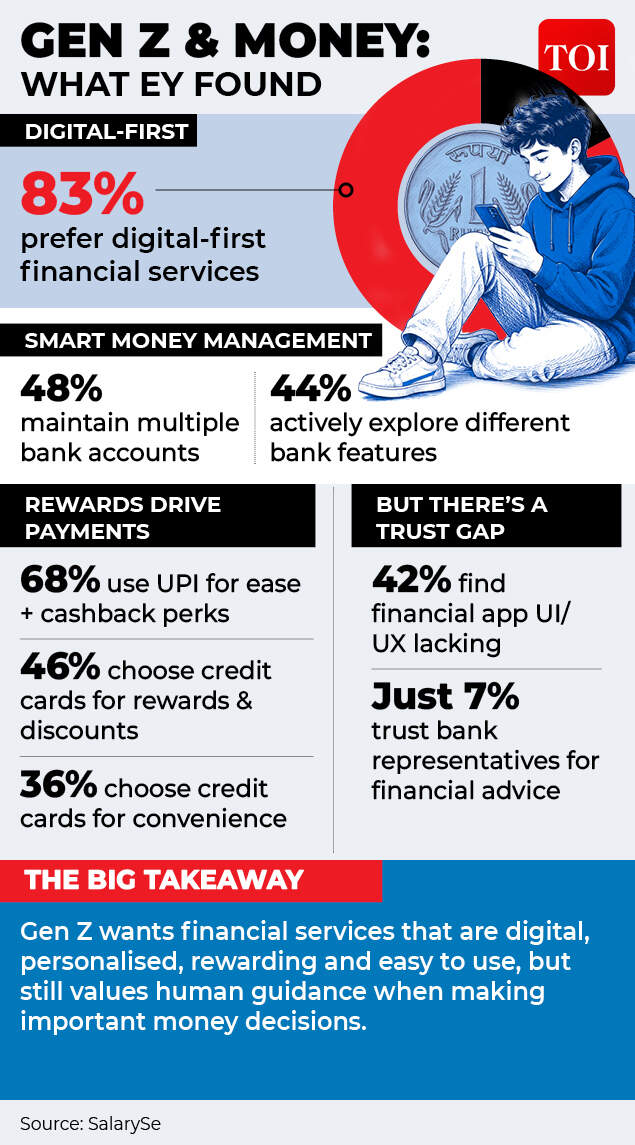
Gen Z & Money: What an EY study found
Spending patterns
Actual transaction data challenges the idea that Gen Z spends most of its money on lifestyle purchases. SalarySe analysed millions of UPI transactions involving more than 5.2 lakh salaried Gen Z users and found that more than 70% of monthly spending goes towards bills and subscriptions, groceries, financial services, shopping and food.Bills and subscriptions account for 20.1% of spending, followed by groceries at 15.7%, financial services at 12.2%, shopping at 11.9% and food at 11.5%. Travel accounts for just 5% of monthly spending.Age makes a difference to the spending mix. Discretionary spending remains unchanged at 32% among both 18-23-year-olds and 24-29-year-olds. Essential spending, however, rises from 50% to 59% as Gen Z gets older. The data suggests that everyday financial commitments take up a larger share of the wallet as young people move through different stages of life.Nirav R Karkera, Head of Research, W by Groww acknowledges that the new generation is taking a distinctly different approach towards personal finance and money management.“None of it is necessarily wrong, but it is certainly different from the patterns we saw with earlier generations,” he says.
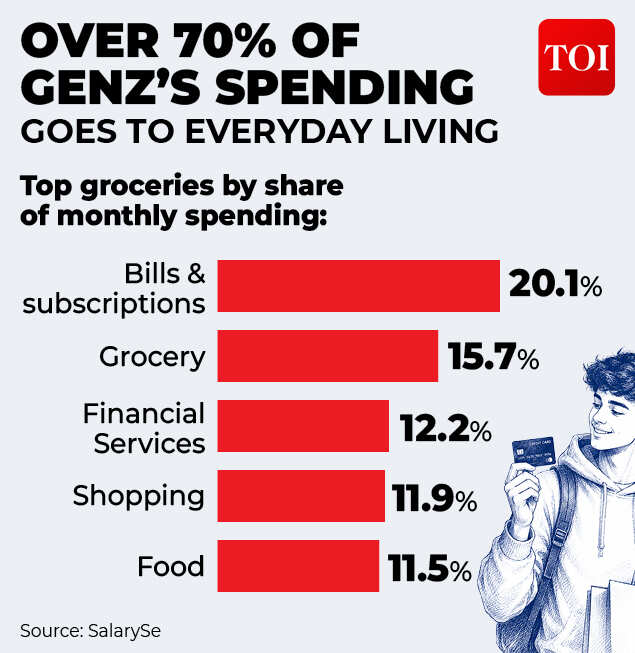
Over 70% of GenZ’s spending goes to everyday living
From saving to investing
Gen Z’s interest in investing is growing, but there remains a sizeable gap between awareness and participation. A SEBI survey has found that 66% of Gen Z is aware of at least one securities-market product, compared with 62% of millennials and 56% of Gen X+. Yet only 9% of Gen Z participates in securities-market products. Six per cent invest in mutual funds or ETFs, while 5% invest in stocks or shares.The pipeline of potential new investors is much stronger. Among SEBI’s “intenders”, those who are not currently investing but plan to invest, 56% are Gen Z, compared with 35% millennials. SEBI also found a high representation of Gen Z among stock investors.The way young people want to learn about investing is changing as well. Eighty-one per cent of Gen Z prefers video-based investor education, particularly short explainers and tutorials.
Mistakes to avoid
So, Gen Z wants a good life, but also wants financial freedom. The real flex? Having your money sorted.While more financially aware and savvy, experts believe that sometimes the risk taking ability needs to be kept in balance.Rohit Shah, Financial Planner sees Gen Z making three mistakes:First, chasing quick money: Piling into direct stocks or crypto off a 30-second reel, mistaking a bull run for skill.Second, ignoring diversification: They forget the surest way to grow money is to not lose it, which is exactly what a multi-asset portfolio quietly does.Third, skipping the basics. From day one: ask why you’re saving, build an emergency fund first, and settle DIY-versus-adviser before chasing returns.Nirav Karkera warns that prioritising fixed lifestyle upgrades and experiences, particularly by dipping into money that should ideally be set aside for contingencies, can leave very little room for the curveballs that life inevitably throws at us.“It is a bit like bungee jumping without first checking whether the harness is strong enough. The adrenaline may be worth it for a moment, but it is not necessarily the smartest way to do it,” he says.Another mistake he points out is trying to find excitement in investing before building a sound financial foundation.Participating in F&O, short-term stock trading, global equities or other speculative opportunities without first developing a foundational understanding of the asset may not be the ideal starting point.“These avenues can have a place in an investor’s journey, but preferably after the basics are taken care of. That means building a contingency fund, securing adequate medical and term insurance, and establishing systematic investments in long-term assets,” he advises.He also says that one should not underestimate the power of starting small, but starting early.Many people believe investing becomes meaningful only once the amount available to invest is large enough. The amount certainly matters, but compounding gives enormous importance to the length of time for which money remains invested.“Starting small and starting early does more than support the wealth-compounding journey. It also gives you time to understand yourself as an investor, experience market cycles and learn investing best practices when the stakes are still relatively low,” he tells TOI.
Managing Debt
Buy Now, Pay Later (BNPL), credit cards, loans and more – the lure of debt is real and with so many EMI schemes in the market, it’s easy to get caught in a debt trap.Debt isn’t good or bad on its own. It depends on your situation, your risk profile and your honest ability to repay.Rohit Shah recommends a simple test: all your EMIs together should stay under 30% of your take-home salary, 40% at the very most.Also, the real distinction is what debt does: good debt buys an asset that builds your future, like education or a home; bad debt just funds consumption today. Cheap credit is the trap, cautions Shah.Nirav Karkera warns that the danger begins when credit creates an illusion of affordability simply because the immediate cash-flow commitment looks small.When using credit, it is important to look beyond the EMI or the monthly payment and understand the total cost of the purchase and the total liability being taken on. You should first ask whether the purchase itself is affordable.“It does not necessarily have to be completely affordable out of a single month’s income. But you should be acutely aware of what you are committing to and have a clear idea of how that liability will be funded, not only if everything goes according to plan, but also if circumstances turn less favourable,” he says, adding that this distinction is important.Sensible borrowing is borrowing that you understand, can absorb and have deliberately planned for.“A debt trap usually begins when the repayment depends too heavily on everything going right,” he says.
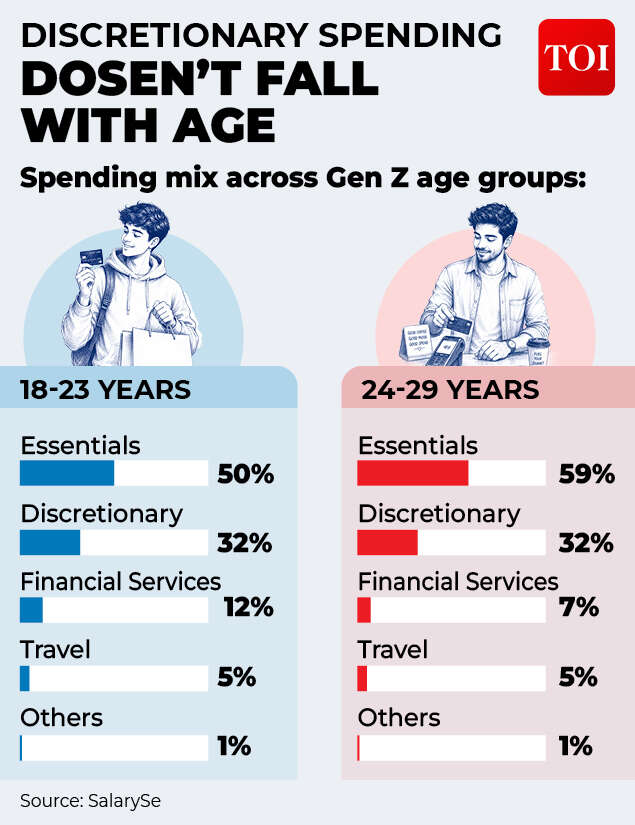
Discretionary spending doesn’t fall with age
What should your money strategy be?
Rohit Shah notes that at 21–22, living with parents with few responsibilities, your savings rate can be huge.“70–80% is realistic, and that window won’t last, so use it hard. Keep six months to a year liquid as an emergency buffer, since near-term goals come fast: a vehicle, a wedding, travel, a first home. But start a long-term equity SIP now – at this age, time in the market is the one edge you can never buy back later,” he says.From a rationality standpoint, Nirav Karkera shares a useful order of priorities.First, define your bare necessary living expenses. Understand what it genuinely costs to run your life before anything else.Second, build some contingency money, enough to tide over at least a couple of months of essential expenses if income were to pause temporarily.Third, protect yourself against large financial shocks, particularly medical contingencies, through adequate health insurance and other necessary protection.Fourth, start setting aside money systematically for long-term investing goals. The amount can increase as income grows, but the habit should begin early.Fifth, invest in your own productivity. That could mean skill development, education, health or anything else that improves your future earning capacity and quality of life.And finally, set aside money for discretionary spending and experiences. Having fun with money is important too. The objective is not to eliminate enjoyment, but to make sure it comes after the more fundamental parts of the financial structure are reasonably secure.As many surveys are suggesting: The generation often labelled as spenders is proving to be more financially conscious than the stereotype suggests. It is learning to manage money digitally, watching everyday expenses and gradually moving towards investing for long-term financial independence.Experts say the broad map to follow is: essentials first, resilience next, protection after that, then long-term wealth creation, self-improvement and discretionary spending.(Disclaimer: Recommendations and views on the stock market, or any other asset classes or personal finance management tips given by experts and analysts are their own. These opinions do not represent the views of The Times of India.)