

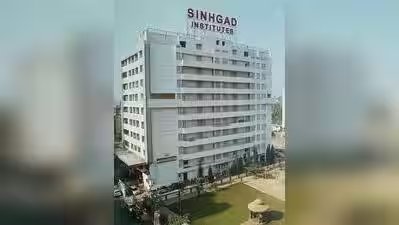
Pune: After years of salary delays, protests, court battles and repeated assurances that failed to materialise, around 6,000 teaching and non-teaching employees of Sinhgad Technical Education Society (STES) are hoping that the Maharashtra govt’s takeover of 32 institutes will finally bring relief.The intervention follows strong observations by Bombay high court, which directed investigations into the society’s affairs and ordered administrative control over several institutions after finding that commitments to clear employee dues had not been honoured.Under the govt’s intervention, seven colleges have been taken over by Directorate of Higher Education for three years, while 25 technical institutions have been placed under an administrator appointed by Directorate of Technical Education (DTE). The move came after the HC’s Nov 10 order, which also directed CBI, Enforcement Directorate and Income Tax authorities to investigate the affairs of the society’s 44 institutes and trustees.The crisis has affected not only the employees awaiting salaries, provident fund dues, retirement benefits and arrears under the Sixth and Seventh Pay Commissions, but also students whose academic schedules were disrupted by repeated protests and staff shortages.Shubham Phalake, a faculty member at a Sinhgad institute in Lonavla, said, “Since 2016, we have been facing financial difficulties, with salaries often delayed by several months. This has taken a severe mental toll on us. We have been regularly protesting to highlight the issue.”The scale of the crisis is evident from the litigation it has generated. According to the HC’s Nov 10 order, around 220 petitions have been filed by teaching and non-teaching employees from 44 institutions. The court noted that outstanding salaries and terminal benefits were stated to exceed Rs 400 crore and that about 13 employees were stated to have died by suicide amid prolonged financial distress.For many employees, the hardship extends beyond delayed monthly salaries. Venkat Patil, who resigned from Sinhgad Institute, Kondhwa, said the prolonged uncertainty had forced experienced faculty members to leave. He said, “The student strength in some departments had fallen from around 480 to just 60, warning that the decline in faculty quality and student numbers could affect future admissions.”Employees at schools run by the group have also faced severe hardship. Sachin Shinde, a member of Sinhgad Institution’s Coordination Committee, said nearly 6,000 employees across the society had not received salaries for around 36 months. He said, “Despite continuous academic work, examinations, accreditation responsibilities, and compliance duties, the management has failed to release our legitimately earned salaries.”A bus driver at a school run by the society in Ambegaon said, “We have not received our salaries for the last 15 months. Not a single rupee of basic pay, academic grade pay or statutory dues has been paid during this entire period.”The salary crisis repeatedly spilled into classrooms. In Feb 2025, around 40 teachers at a Sinhgad society school Kondhwa stopped taking classes and staged a protest over unpaid salaries just weeks before examinations. The disruption resurfaced in Jan 2026 at the Ambegaon school, where teachers and bus drivers went on strike, prompting parents to join demonstrations.Parent Sunil Belekar said, “Due to the non-payment of the teaching and non-teaching staff, the education of our wards was halted. The teachers and bus drivers went on strike, and we parents and children were facing the brunt of it. Examinations in Hindi, Marathi and mathematics remained pending during the strike despite parents paying fees on time.”Another staff member, Pawan Kolte, said salary arrears spanning several years remained unpaid. “We have reached out to the District Collector and even the PMC Commissioner and police, but our issues haven’t been resolved,” he said.The crisis has been building for years. In Dec 2017, nearly 1,000 teachers from eight Sinhgad colleges went on strike after receiving around 40% of their salaries for months. The agitation continued into 2018. At the time, faculty member Gangadhar Ashokh Jagdale had said their salaries were getting delayed for over 10 months.The management had attributed the delays to pending govt scholarship reimbursements and fee-related issues. In an affidavit submitted in Aug 2026, the society cited financial difficulties arising during and after the Covid-19 pandemic and the non-disbursement of tuition fees for students from reserved categories. HC, however, questioned why salaries remained unpaid despite fee collections from other categories of students.In Sept 2026, the court observed that the institution’s conduct reflected “apathy or illegality” and directed govt departments to deposit Rs 27.91 crore in pending reimbursements into court. The situation escalated further after managing trustee Maruti Navale assured the court on Nov 6 that Rs 60.65 crore would be released to petitioners by Nov 7. The court later recorded that not a single rupee had been paid and froze the society’s bank accounts and investments pending investigation.DTE in-charge director Pramod Naik said complaints regarding salaries and arrears had been forwarded to Savitribai Phule Pune University. The directorate subsequently appointed the joint director of technical education, Pune, as administrator for 25 technical institutions.Navale had said the management would cooperate with the authorities. “We have always abided by the orders passed by Bombay HC and will continue to do so. We will extend our full cooperation to the DTE and the authorities in implementing the decision to take over the management of our colleges. We have no other option but to comply with the court’s directions and whatever further decisions are taken by the authorities.”Students remain equally anxious. A student from a Sinhgad college in Wadgaon said, “We enrolled in the course expecting regular lectures and practical training, but there have been periods when classes were disrupted because faculty members were unavailable. We have also had to depend on students and informal groups to find out whether lectures would be conducted. We are worried about completing the syllabus and being adequately prepared for examinations.”With the next high court hearing scheduled for Nov 19, staffers and students alike are waiting to see if the latest intervention finally ends a crisis that has persisted despite years of assurances.