


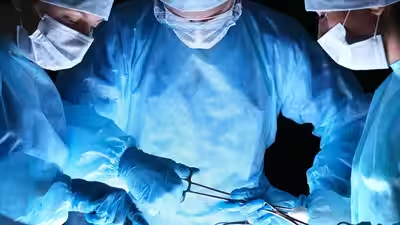
BENGALURU: More than 300 people—doctors, hospital staff, schoolchildren, philanthropists, friends and complete strangers—came together to raise nearly Rs 30 lakh for a newborn they had never met. Their collective effort helped make possible what doctors believe is India’s first successful limb-salvage treatment in a 28-day-old baby diagnosed with Infantile Fibrosarcoma (IFS), one of the rarest soft-tissue cancers seen in newborns. When Pavan (name changed) welcomed his daughter in December 2024, he noticed a small reddish swelling, about 3 cm in size, on her right hand. An MRI was performed the same day, but within weeks, the swelling had transformed into an aggressive tumour measuring over 11 cm—almost as large as the baby’s head. Multiple hospitals told the family that the cancer was growing so rapidly that amputation was likely the only option. “She was only 20 days old. We were devastated when we were told that surgery at that age would be extremely difficult and that amputation of her hand was probably the only option,” said Pavan, a Bengaluru-based 3D visualiser. “People say ‘amputation’ as though it is just another medical term. But for a parent, it’s a small word that carries an unimaginably heavy weight.” The baby was diagnosed with Infantile Fibrosarcoma, an exceptionally rare cancer. Globally, fibrosarcoma has an incidence of just 0.3 per 100,000 population, while Infantile Fibrosarcoma accounts for less than 1% of all soft-tissue sarcomas. Doctors say comparable limb-preservation cases have largely involved older infants, making this among the youngest reported cases worldwide. When the family reached HCG Cancer Centre in Bengaluru, Dr Pramod S Chinder, Director and Head of Musculoskeletal Oncology, decided to attempt a complicated procedure. “In my 16 years of practising orthopaedic oncology in India and abroad, I had never seen a tumour of this size in such a young infant,” he said. “Many colleagues felt amputation was the only realistic option. But I believed there was still a small possibility of saving the limb, and we felt we owed the family that chance.” The treatment involved genomic testing, Digital Twin-assisted 3D surgical planning, super-selective micro-embolisation to cut off the tumour’s blood supply, high-precision tumour removal, neonatal microvascular reconstruction, and NTRK-targeted therapy. More than 14 specialists worked together, and the treatment strategy was also reviewed with experts at Italy’s Rizzoli Orthopaedic Institute. But as the team planned the surgery, another obstacle surfaced. The estimated cost of treatment—between Rs 30 lakh and Rs 35 lakh—was beyond the family’s means. “One night, the father called me and said he simply couldn’t afford it,” Dr Chinder recalled. “I told him, ‘Your job is to be a father. Don’t worry about the bill. We’ll find a way.'” This was followed by a fundraising effort. Through the HCG Foundation, the doctor’s family foundation and an informal network of supporters, hundreds of Bengaluru residents pitched in. Schoolchildren organised collections, doctors quietly donated, hospital staff contributed, and friends and well-wishers came forward. Now nearly a year later, thebaby girl is cancer-free, has full use of her right arm and is growing like any healthy child. Pavan said, “she recently tried to lift a watermelon with her hand. We are happy she can now grow up like any other child.”