



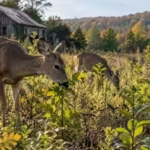






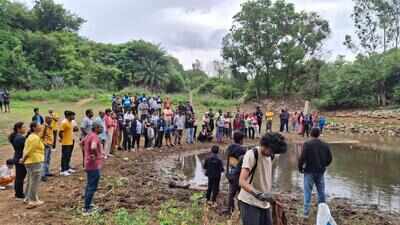
Bengaluru: Every Sunday morning, before the city’s roads fill with traffic, groups of curious residents gather at the gates of Bangalore University’s Jnanabharathi campus. Armed with binoculars, cameras and boundless curiosity, they venture into the sprawling 330-acre Bio Park, discovering butterflies, birds, snakes, towering native trees and even billion-year-old rock formations tucked away in one of the city’s largest surviving green spaces.Leading the walks is 28-year-old herpetologist Yashas Bharadwaj, joined by 69-year-old former geology professor TJ Renukaprasad. Together, the unlikely duo has transformed a weekly nature walk into a quiet movement to protect Bengaluru’s urban wilderness.For the past 63 Sundays, Bharadwaj has been leading free nature walks in association with the Jnanabharathi Vayuviharigala Sangha (JVS), introducing residents to the remarkable biodiversity within the university campus. What began as a small gathering has grown into a thriving community initiative, attracting 60 to 70 participants almost every week and occasionally drawing crowds of up to 300. Special walks are also organised for schoolchildren on request.For Bharadwaj, an alumnus of Indian Institute of Science (IISc), the walks are more than guided tours — they are an investment in conservation. “I realised if people don’t know what exists here, they won’t stand up for it when it’s threatened. The best way to protect a forest is to help people fall in love with it first,” he said.His association with the Bio Park dates back nearly a decade. In 2016, he was commissioned to document the park’s biodiversity and submitted a detailed survey in 2018, recording its rich diversity of reptiles, butterflies, birds and other wildlife. When he returned in 2024 after several years away for work, he found the green cover had shrunk from around 400 acres to just over 300 acres, while development proposals had begun to eye portions of the land.Along with fellow nature enthusiasts, Bharadwaj challenged some of these proposals in court. But he soon realised that legal interventions alone would not secure the park’s future. “The real protection has to come from citizens. If people understand why these ecosystems matter, they will become their strongest defenders,” he said.That vision found an ally in Renukaprasad, who has spent more than two decades nurturing the Bio Park ever since it was conceptualised under environmentalist Yellappa Reddy and inaugurated in the early 2000s.A former dean of Bangalore University and its designated officer for the Bio Park, Renukaprasad has watched generations of trees grow across the campus. Today, the park stretches across 330 acres, housing nearly 1,000 varieties of trees, around 180 species of birds, 150 varieties of butterflies, several species of snakes and countless insects, including rare spiders.Helping others understandFor him, opening the park to the public was essential. “If people don’t speak for these spaces, someone else will decide their future. These walks help citizens understand not just the biodiversity but also the geological heritage of this landscape, which contains some of the oldest rock formations in the world,” he said.Every walk combines lessons on ecology with stories about Bengaluru’s natural history. Participants learn how snakes help maintain ecological balance, why native trees support more wildlife than exotic species, and how even seemingly ordinary insects play a vital role in sustaining the ecosystem. The walks have attracted students, professionals, photographers, families and senior citizens, many returning several times to experience the changing landscape through different seasons.For Bharadwaj and Renukaprasad, the growing crowds offer hope that conservation need not begin with policy — it can begin with curiosity. “We are not against development. But it should not come at the cost of nature. If we want Bengaluru to remain liveable, we must protect spaces like this for future generations,” Renukaprasad said.