









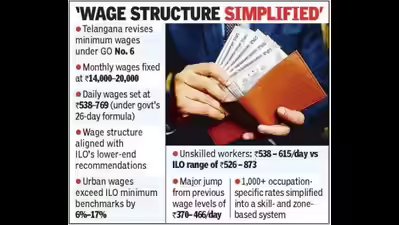
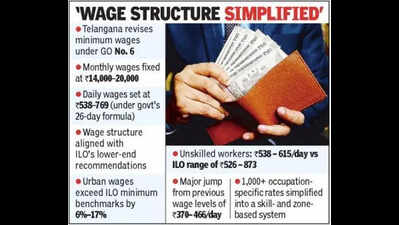
Hyderabad: Telangana’s recent minimum wage revision is more than a technical notification—it is a statement about the state’s priorities in balancing international standards with local economic realities.By aligning its wage structure with the lower-end recommendations of the International Labour Organisation (ILO), the govt has taken a cautious yet progressive step. The ILO study had recommended daily wages between ₹526 and ₹873 for unskilled workers, ₹579 to ₹960 for semi-skilled, ₹652 to ₹1,083 for skilled, and ₹728 to ₹1,208 for highly skilled workers.In contrast, Telangana has fixed daily wages at ₹538 to ₹615 for unskilled workers, ₹577 to ₹654 for semi-skilled, ₹635 to ₹712 for skilled, and ₹692 to ₹769 for highly skilled workers.The revised framework, notified through GO No. 6, sets minimum monthly wages between ₹14,000 and ₹20,000, translating into daily earnings of about ₹538 to ₹769 under the govt’s 26-day wage formula.While these figures exceed the ILO’s minimum benchmarks in urban areas—by about 17% for unskilled workers and between 6% to 13% for other skill levels—they remain firmly anchored to the lower end of the recommended spectrum.For instance, although the ILO estimated that an unskilled worker would require up to ₹873 per day, Telangana capped the category at ₹615. Similarly, highly skilled workers were assessed to need as much as ₹1,208 per day, but the state’s notified wage peaks at ₹769.This adjustment nonetheless marks a significant leap from the previous wage levels of around ₹370 for agricultural and ₹466 for non-agricultural work. Beyond the numbers, the new framework introduces structural reforms by simplifying the wage system.Over 1,000 occupation-specific rates have been rationalised into a skill- and zone-based model, reducing complexity for employers while incorporating several recommendations from the ILO study. By streamlining categories and compliance requirements, Telangana has attempted to modernise its wage policy while ensuring that workers at every skill level see tangible improvements in their earnings.The revision, therefore, represents both progress and compromise–progress in lifting wages above outdated benchmarks, and compromise in stopping short of the aspirational living-wage levels envisioned by international standards.