









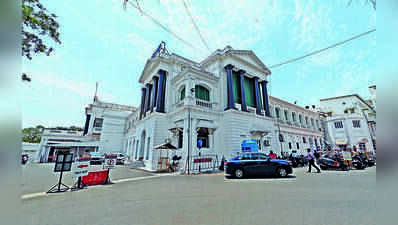
K Ashok Vardhan ShettyFor a quarter-century, successive govts have sought to relocate Tamil Nadu’s secretariat from Fort St George. Every proposal provoked controversy and was eventually abandoned; even the one completed complex was repurposed into a multi-speciality hospital.The secretariat is best retained at Fort St George. Its congestion-related drawbacks are outweighed by its central location, excellent transport connectivity, and proximity to the principal govt directorates. Nearly four centuries of administrative continuity should not be lightly discarded; nor should relocation separate the Secretariat from these directorates, weakening coordination and inconveniencing citizens and officials alike.If a new complex becomes unavoidable, it should neither be shoehorned into Chennai’s congested core, worsening traffic, pollution, land pressure, and infrastructure strain, nor built on the periphery without a comprehensive plan that creates an isolated administrative enclave.Tamil Nadu should seize the opportunity to create India’s first truly compact, vertical, and climate-resilient satellite city near Chennai, anchored by the new secretariat, legislative assembly, and key govt offices. Such institutional ‘seeding’ would provide an immediate economic engine. Relocation could also release several valuable beachfront parcels in Chennai —occupied by govt offices and public housing — for premium commercial and civic redevelopment, beautifying Chennai’s coastline and financing satellite-city infrastructure. Fast shuttle services operating every 15 minutes should connect the satellite city with Chennai.Earlier satellite cities replicated their parent cities’ deficiencies. Tamil Nadu should pioneer a fundamentally different model, designed for the age of climate change and drawing upon global expertise in urban planning, architecture, transport and ecology.India was only 31% urban according to the 2011 Census, yet had the world’s second-largest urban population. In 2025, Demographia identified 66 million-plus urban areas, while the United Nations recognised five megacities with populations of more than one crore, Chennai among them.Until the early 2000s, public policy remained predominantly rural-centric, relegating urban governance to an afterthought. Consequently, cities expanded haphazardly, producing proliferating slums, vanishing green and open spaces, transport failure, drinking-water scarcity, air pollution, recurrent flooding, insufficient sewage treatment, and degraded water bodies. The runaway growth of megacities risks turning chronic dysfunction into systemic collapse.Much of this crisis arises from the conventional model of urban expansion. The permissible Floor Space Index (FSI) — the ratio of total built-up area across all storeys to plot area — is constrained by an area’s infrastructural capacity. Narrow roads and inadequate civic infrastructure restrict average FSI to between 1 and 2 in most Indian cities. Unable to grow vertically, cities expand horizontally by absorbing adjoining municipalities, town panchayats, and villages. Yet these peripheral areas have narrower roads, weaker infrastructure, and lower FSI than the parent city, perpetuating urban sprawl. Each horizontal expansion creates the conditions for the next.Sprawl lengthens commutes, intensifying traffic congestion, air pollution, and greenhouse-gas emissions. It also buries farmland, wetlands, floodplains, and groundwater-recharge zones beneath impervious concrete and asphalt, aggravating urban flooding. Extending civic infrastructure across ever-widening, low-density areas raises per-capita costs, making comprehensive provision uneconomical.If India struggles when barely one-third of its population is urban, how will it cope when one-half or more lives in cities, and climate change intensifies heat, erratic rainfall, and extreme weather? Fortunately, the same measures that reduce urban greenhouse-gas emissions — compact vertical development; public transport, cycling, and walking; green infrastructure; resource recovery from waste; and energy-efficient buildings — can also tackle several urban crises simultaneously. Retrofitting this climate-resilient model into established cities is prohibitively expensive and disruptive. Planned greenfield satellite cities therefore offer the most practicable means of relieving India’s overstretched metropolises such as Chennai.The satellite city should grow vertically, limiting sprawl and extent — and cost — of civic infrastructure. For example, if a parent city of one crore people occupies 500sqkm at an average FSI of 1.2, a satellite city with an average FSI of 6 could theoretically accommodate the same population within a compact 100sqkm.Compactness enables mobility to be organised around people rather than automobiles. A ‘15-minute city’ design can make most daily needs accessible by walking, cycling, or public transport. Broad streets, needed to support higher FSI, should accommodate wide footpaths, protected cycle tracks, and dedicated bus rapid transit lanes, supplemented by light rail or metro where warranted. Private vehicles should be restricted, subject to essential exceptions.Most Indian cities suffer from a chronic shortage of green and open spaces. The satellite city must be ‘biophilic’, reserving at least 25% of its land for greenery and 8% for public open spaces. Preserve existing lakes, wetlands, and natural drainage channels. Urban forests, constructed wetlands, neighbourhood parks, avenue trees, green medians, bioswales, and green roofs and walls in buildings should be integral to its design. Together, they would improve public well-being, sequester carbon, reduce flooding, recharge aquifers, mitigate urban heat, clean the air, support biodiversity and beautify the city.India treats barely 28% of urban sewage. The satellite city should treat all wastewater for reuse in construction, landscaping, and other non-potable applications. Converting organic waste into compost or biogas, construction debris into aggregates, and glass and metals into reusable inputs would create a low-carbon ‘circular economy’.Drawing inspiration from the energy-positive neighbourhoods of Freiburg, Germany, the satellite city should pursue ‘net-zero energy’ through low-embodied-carbon building materials, energy-efficient appliances, natural lighting, passive cooling using courtyards, atriums, and breezeways, and rooftop and façade-mounted solar panels that generate clean power.After the controversy over land acquisition for the proposed Parandur airport, acquiring a larger area for a satellite city could be politically contentious and socially disruptive. Transparent land pooling offers a better alternative. Gujarat, Delhi, Andhra Pradesh and Maharashtra provide useful precedents.The planning authority consolidates fragmented holdings, reserves the land required for roads, public transport, utilities, green spaces, and other infrastructure, and returns the remainder as reconstituted, development-ready plots. Although smaller, these plots could become more valuable than the original agricultural holdings because of their road access, civic infrastructure, higher FSI, and development rights. Based primarily on voluntary participation, with compulsory acquisition strictly a last resort, pooling gives landowners a continuing stake in the city rather than one-time compensation.A stand-alone secretariat would be merely another govt complex—and, if poorly located, another burden on Chennai. Integrated with the legislative assembly and key departments as the anchor of a greenfield satellite city, it could redirect Chennai’s growth and make Tamil Nadu a national exemplar of climate-resilient urbanisation.(The writer is a retired IAS officer, and a member of the Justice Kurian Joseph Committee on Union-State Relations)