








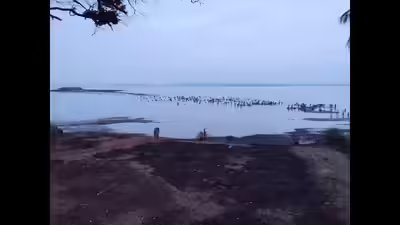
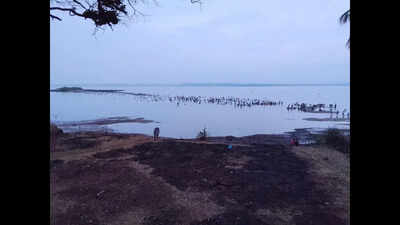
Panaji: The re-emergence of the endangered flagship windowpane oyster (placuna placenta) in Chicalim bay after several years has enthused locals, but unregulated harvesting has triggered concern as pickers are ransacking the delicacy.With water levels receding before the monsoon, scores of collectors from outlying areas arrive near St Jacinto island as early as 3am, wading into risky waters and carrying away massive quantities before high tide.Despite Goa State Biodiversity Board (GSBB) guidelines notified in Sep 2022 for sustainable extraction of clams (tisreo) and other shellfish, locals allege that windowpane oyster extraction has turned into “loot and plunder”, and that the Chicalim biodiversity management committee (BMC) has been ineffective.“The raiders from even distant areas enter the habitat, creating a hurdle for our locals and their livelihoods. Three women nearly drowned recently and were rushed to a nearby hospital,” a fisherman said.Locally called ‘menddio’, the species is widely craved fried or cooked, but in Chicalim bay it occurs “only as a brood stock”. Union govt included it in Schedule IV of the Wildlife Protection Act and banned its extraction. Harvesting is allowed around Vareg island, off the Vasco–Cortalim road, to support ethnic livelihoods, and in recent years, extraction has been small-scale.Chicalim bay is a key breeding site for clams, oysters, and other shellfish along the west coast. A report compiled by Baban Ingole and other NIO scientists warned that the habitat faces threats from overexploitation, metal pollution, and destruction. The study, conducted across 15 stations over one year, extending beyond St Jacinto island in the Zuari river, found that on average, about 10,000 windowpane oysters are harvested daily in Chicalim bay.“The issue is not just about food, but how unregulated harvesting of tisreo and menddio can impact rejuvenation of the brood stock and biodiversity as a whole,” local resident Johnson Stephen said.Resurgence in menddio — possibly due to favourable spawning conditions — has increased footfall at the endangered habitat. “GSBB guidelines envisage restricted shellfish collection only by locals within a 5-km radius and use of only traditional hand-picking,” Stephen said.BMC chairperson Rui M Costa Araujo said the BMC is struggling to restrict collectors who swamp the site “in hundreds”, especially on Sundays. “We have gone around requesting them to pick only fully grown tisreo,” he said and added that the GSBB, at the BMC’s request, instructed Vasco police to help control the crowd, “But so far, they have not appeared at the site,” he said.The guidelines also recommend a closed season from July to Oct for breeding, levying extraction fees, and other restrictions, including “no-take zones” for conservation.“The extraction of shellfish resources goes back to the era of early human footprint – an activity signifying primitive survival,” said Cyril Fernandes, chairperson of the Chicalim Villagers Action Committee. He said the broodstock needs conservation to ensure rejuvenation. “Down the centuries, this traditional method has continued sustaining coastal communities.”Locals have petitioned govt for a heritage tag for Chicalim village. “Govt is seized of the matter, and such a status will greatly facilitate protection of this bivalve habitat,” Araujo said.‘No-take zones’ are “inevitable to preserve the germ plasm of Goa’s shellfish species, like the green mussels, which are difficult to find and may also show decline,” Ingole said.