






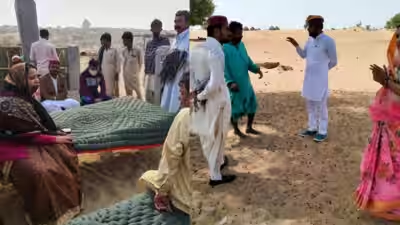
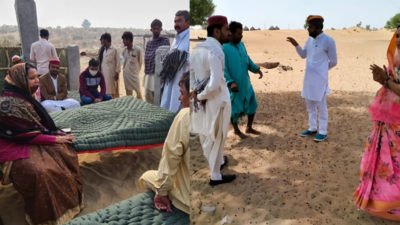
JAISALMER: The upcoming Panchayati Raj elections in Jaisalmer district present an unusual challenge, with geography emerging as a major factor in campaigning. Following the latest delimitation exercise, Block No. 1 (Shahgarh) of Khuhri Panchayat Samiti has potentially emerged as one of Rajasthan’s largest panchayat samiti wards, stretching nearly 200km from one end to the other.The distance between Ghotau village in the block and Gangu Ki Beri hamlet near Rahu Ke Paar is around 200km. In many parts of Rajasthan, travelling this far would mean crossing two or three district boundaries. However, in Jaisalmer’s remote border region, the entire stretch falls within a single panchayat samiti member’s constituency.For candidates contesting from this vast, sparsely populated area, reaching voters in scattered hamlets is likely to be a major challenge. The region lacks proper paved roads and mobile network connectivity, making election campaigning and voter mobilisation particularly difficult.The block comprises five gram panchayats — Shahgarh, Dhanana, Navatala, Harnau and Balidada Ki Basti. Navatala has 43 revenue villages, Shahgarh 30, Harnau 22, Dhanana three and Balidada Ki Basti two. Together, they account for 100 revenue villages and hundreds of scattered hamlets.Liaquat Ali, a local resident and the unopposed sarpanch of Nimba village, said the geographical challenges could directly affect the electoral process. Voters living in remote hamlets may have to travel 30 to 50km along sandy tracks to cast their votes.He said candidates would face a formidable task reaching every household across the nearly 200km-long constituency, requiring considerable time, physical effort and financial resources.Kherdin, a candidate contesting from the Shahgarh block, said the constituency’s vast geographical spread had made election management particularly complicated. Despite covering such a large area, the five gram panchayats have a combined electorate of around 5,800.Shahgarh has approximately 1,200 voters, Navatala 1,000, Dhanana 850, Harnau 1,200 and Balidada Ki Basti around 1,600.Kherdin said most residents lived in isolated hamlets and frequently moved with their livestock. Mobilising them to reach polling booths would require dozens of four-wheel-drive (4×4) vehicles capable of navigating long stretches of sandy and unpaved tracks.“In the absence of paved roads and mobile connectivity, sending vehicles across these remote tracks to bring voters to polling booths will be an extremely challenging exercise. It will require additional money, time and a fleet of 4×4 vehicles,” Kherdin said.He added that campaigning across such a vast constituency would test candidates both physically and financially, as they would have to cover considerable distances to reach voters in remote settlements.Sagron Ki Basti block also poses a challengeShahgarh is not the only geographically extensive constituency in Khuhri Panchayat Samiti. Block No. 2, Sagron Ki Basti, also covers a large area, with a distance of around 50 to 60km between its farthest points.The block includes five villages under Turk Ki Basti, five under Sagron Ki Basti and two under Nimba panchayat. It has approximately 6,500 voters.Candidates contesting from this block will also have to travel extensively across sandy dunes and remote settlements to reach voters.As the Panchayati Raj elections approach, these sprawling constituencies highlight how the geography of Rajasthan’s remote western border region can turn campaigning and voter mobilisation into a major logistical challenge.