









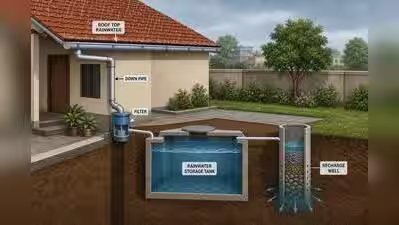
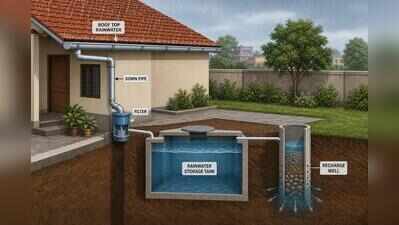
Pune: A lack of expertise to execute rainwater harvesting projects – domestic or otherwise – remains a major obstacle even in an era when demand for conserving rainwater is steadily growing.In many cases, rainwater harvesting systems have been reduced to a basic plumbing exercise – confined to installing a few pipes and a storage tank – which is deemed to defeat its purpose, as per experts.According to experts, several norms have been set by the central as well as state govts to promote rainwater harvesting (RWH). RWH systems are mandatory for any building on plots above 500 square metres (sqm). Even the building permission plans must show RWH structures.It is checked while giving the completion certificate. Non‑compliance attracts a fine of ₹1,000 per year per 100 sqm of the built‑up area. Compliant structures get FSI exclusion and often property tax rebates. Despite all these schemes, installation of rainwater harvesting remains low. Non-availability of trained people for installation is one of the key reasons behind it.Experts have been advocating for Industrial Training Institutes (ITIs) and vocational training centres to introduce specialised certification courses to address such a skill gap. The curriculum, they suggested, should cover fundamental studies on local aquifers, rainwater harvesting mechanics, and key geological and environmental factors.Furthermore, these courses, if incorporated, must have practical training on system maintenance following installation, the experts said.“Rainwater harvesting training is a must. The process needs knowledge of science, technology and several other aspects. The course should have the synergy of these aspects. The syllabus should be designed accordingly,” said Himanshu Kulkarni of Advanced Center for Water Resources Development and Management (ACWADAM), an organisation working in the field of groundwater.As per civic officials, on average between 2,000 and 2,500 building permissions are given annually, and the civic body has made it mandatory to install rainwater harvesting for new constructions. Experts, however, argued that rainwater harvesting has reduced to a formality in the majority of cases. The management committees of many societies hire local agencies, who employ local plumbers and complete the works.Col Shashikant Dalvi (retd), a rainwater harvesting expert, said a monitoring system was required to make the rainwater harvesting systems effective. “Many agencies have come up in the business of rainwater harvesting. Most of them hire inexperienced staff. A mechanism should be introduced to train these people,” he said.Civic data showed that during the 2025–26 financial year, dedicated rainwater harvesting recorded the lowest uptake among property tax concession categories, with just 4,846 out of 1,56,993 eligible properties registered for the rebate.This measure alone represented a mere 3.09% of the total beneficiaries, placing it at the bottom of the distribution breakdown. In contrast, other standalone initiatives saw considerably higher participation, led by vermicomposting on 47,418 properties (30.27%) and solar power panels installations at nearly 32,946 properties (20.97%).As per the data of PMC’s property tax department, between 2019-20 and 2025-26, property owners availing rebates strictly for rainwater harvesting grew modestly from 2,532 to 4,846. In comparison, standalone solar installations grew over threefold (from 10,713 to 32,946 properties) over the same period.“PMC has empanelled experts who would guide the citizens on the installation of such systems. The property owners who wish to get the fittings done can approach the civic body,” said a senior official of PMC.