








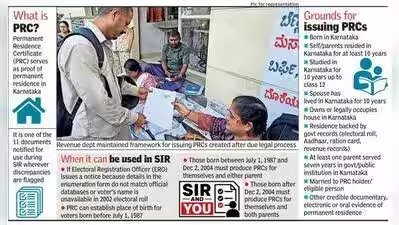
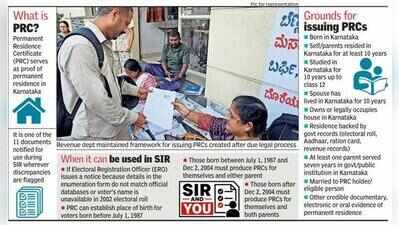
Bengaluru: Karnataka govt will begin issuing Permanent Residence Certificates (PRCs) at nearly 7,000 centres, including Atalji Janasnehi Kendras and Bapuji Kendras, from July 21 (Tuesday).While it remains unclear whether PRC alone will be sufficient for enrolment in the electoral roll during the Special Intensive Revision (SIR), senior Election Commission of India (ECI) officials told TOI PRCs issued lawfully by competent authorities such as tahsildars, deputy commissioners and additional deputy commissioners would be accepted. “If PRCs are lawful then we will accept it. However, no executive order can be considered in the case of the PRC,” a senior ECI official said.State election authorities declined to comment on whether PRC alone will suffice, saying the issue will arise only during the claims and objections period beginning Aug 17.PRC has become politically contentious after Union minister Shobha Karandlaje sought Union home minister Amit Shah’s intervention, alleging there was no constitutional or statutory basis for creating the category of “permanent residents”. ECI’s position, however, indicates that a lawfully issued PRC will be admissible during SIR.The revenue department maintained the framework for issuing PRCs has been created after following due legal process. “We have not only looked at the process followed by other states in issuing their certificates, but also the clarity given by the additional chief electoral officer of West Bengal in terms of admissibility of PRC as one of the documents for SIR in that state,” additional chief secretary (revenue) Rajender Kataria said.According to the govt order, PRC framework has been issued under Articles 162 and 166 of the Constitution, read with Karnataka Land Revenue Act, 1964, Karnataka Land Revenue Rules, 1966, Karnataka Land Grant Rules, 1969, and Karnataka Sakala Services Act, 2011. It also states that the guidelines will not override any eligibility condition prescribed under any Act, rules, govt order or other statutory provision.Explaining the safeguard, Kataria said: “If these guidelines are in conflict with special laws, for instance, SC/ST laws, Income Tax Act or Passport Act, then the special law prevails.”The rollout, originally scheduled for July 6, was delayed to integrate an online application module and inter-departmental verification system. ”It will be rolled out at 7,000 centres at AJSKs and Bapuji Kendras that already provide other services and certificates,” Kataria explained.