






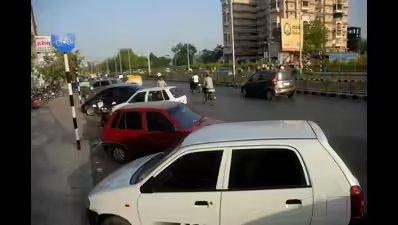
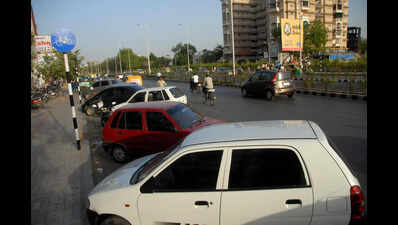
Ahmedabad: The govt is mulling charging private vehicle owners a fee for parking on public roads during the day or night, aiming to free up city road space. A preliminary survey ordered by the state-led High Level Committee for Urban Planning has found that two-wheelers and four-wheelers parked on roads occupy about 30% of arterial road space, translating into 1 to 1.5 lanes clogged on these roads.In Ahmedabad, an ongoing survey by Ahmedabad Urban Development Authority (Auda) indicates that more than 20 lakh two-wheelers and 4 to 5 lakh vehicles are on city roads on any given busy day.“As part of Ahmedabad’s 2040 Development Plan, the govt is weighing a policy where even overnight parking on public roads will incur a fee. Under this framework, the cost of occupying a street will no longer be a flat rate. Instead, pricing will be determined dynamically, factoring in both the “specific location and the time of day,” a senior urban department official said.Officials said the Ahmedabad exercise will be replicated in other major Gujarat cities — Surat, Rajkot and Vadodara — after the survey is completed. “Parking on roads is set to emerge a major urban crisis in future and there is an urgent need to regulate it. Post survey, once the framework is decided, pay to park will be implemented across major cities,” said an urban department official.Sources in Auda said the push for a market-led approach is backed by an ongoing study of 19 major arterial corridors, including Iskon Road, Drive-in road and Nehru Nagar. “Preliminary data reveals that parked vehicles in Ahmedabad currently swallow 20% to 30% of road capacity, effectively utilising 1 to 1.5 lanes on the city’s busiest thoroughfares. Reclaiming this space is projected to boost road efficiency and mobility by at least 15%. This shift treats road space as a commodity that is bought and sold in the market,” said an Auda official.Another senior Auda official involved in the Comprehensive Mobility Plan (CMP) said the current “parking paralysis” stems from treating public land as a private garage. “Vehicles are private; parking also has to be private,” the official stated, adding that homeowners and businesses must take responsibility for vehicle storage rather than shifting the cost onto city infrastructure.Urban department officials said earlier enforcement efforts, including a 2017 crackdown, brought immediate improvements in traffic flow before “disappearing” due to a lack of sustained pressure.To avoid a repeat, the 2040 plan proposes an integrated governance model, with traffic management brought under the Ahmedabad Municipal Corporation (AMC), so the agency building roads is also accountable for safety and traffic flow.While cities like London have halved annual road fatalities since 2005, Ahmedabad’s death toll has risen from 240 to about 500 over the same period, officials said. Statistics show 95% of victims are pedestrians, cyclists or two-wheeler riders.