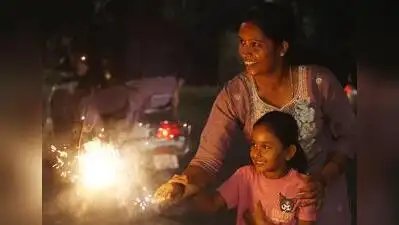







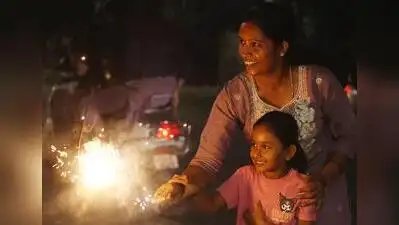
Bengaluru: Deepavali fireworks that lit up the sky on Sunday night came with a heavy price: Bengaluru’s Air Quality Index (AQI) jumped from 53 on Saturday to 129 on Monday, pushing it from the ‘satisfactory‘ to the ‘moderate‘ category.It’s a poor consolation Bengaluru is not as bad as Delhi, whose air quality hit a peak of 370. Compared to Deepavali celebrations in 2025, Bengaluru recorded a nearly 25% increase in AQI on the first day of the festival, with the reading rising from 82 (satisfactory) last year to 102 (moderate) at midnight on Sunday this year. The AQI continued climbing through the night, rising 3-4 points every hour before peaking to 133 around noon on Monday.Data from Air Quality Portal of Central Pollution Control Board (CPCB) shows that Bengaluru’s AQI remained largely stable through the first week of Nov, fluctuating between 53 and 74 after touching 91 on Nov 1.According to the data recorded by CPCB at 8am Monday, right after the festival night, KSR railway station (Majestic) recorded the worst air quality in the city — an AQI of 228 — with PM10 as the dominant pollutant, placing it in the ‘poor‘ category. Silk Board, one of most congested junctions, recorded 152 based on PM2.5 levels, while Hombegowdanagar registered 139 and Jayanagar 5th Block recorded 135. Hebbal, a traffic corridor, reported an AQI of 121.The recorded data showed that Bengaluru’s overall AQI stood at 74 on Sunday at 8pm, when the permitted cracker-bursting window began. It touched 85 by 10pm, when the official window closed. However, the AQI began worsening thereafter, crossing 93 by 11pm. By midnight, it had breached the 100 mark to touch 102, moving from the ‘satisfactory’ to the ‘moderate’ category.The fact that Bengaluru’s wind and rain help disperse pollutants faster than in other cities, should not be seen as a lack of impact. “Fine particles released from crackers and other combustion sources remain harmful to human health, especially for those living or travelling near busy traffic corridors,” said air-pollution expert Dr Manisha Mishra, assistant professor at Azim Premji University.Forest, environment and ecology minister Ramalinga Reddy told TOI pollution levels were relatively low in 2025 because it had rained and fewer people chose to burst crackers. “Police (who had the mandate) should have cracked down on those bursting crackers beyond the permitted hours,” he said.Karnataka State Pollution Control Board chairperson B Shivanna said if restrictions are strictly enforced, many will “brand us anti-tradition or anti-religious, arguing that they burst crackers only once a year. Unlike water pollution, where we can identify specific sources, the entire city is responsible for this, and we cannot blame any one person.”BOXTop 5 Pollution Hotspots on Monday, 8 am (Source: CPCB)Location AQI Dominant PollutantCity Railway Station (Majestic) 228 PM10Silk Board 152 PM2.5Hombegowda Nagar 139 PM2.5Jayanagar 5th Block 135 PM2.5Hebbal 121 PM10