









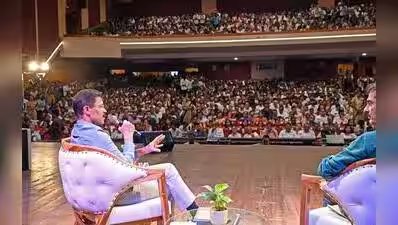

Pune: Is your Diwali social media feed flooded with action against adulterated khoya, spices, warehouses and ingredients used to make sweets, as it is with festive posts? Have you come across reels featuring a man in a fitted blue shirt crushing a laddoo in his hand to test its quality? Well, he is FDA commissioner Tukaram Mundhe, the man behind these viral videos and his crackdown on food adulteration and allied activities has taken the internet by storm. But he is not alone.A month ago, Pune’s own activist Vidyanand Bapat dared to argue against loud music breaching all noise norms in Maharashtra’s largest festival—Ganeshotsav. Youth activist and CJP founder Abhijeet Dipke talks about the biggest anxiety of majority parents in India- good education for their children. Together, Vidyanand Bapat, Tukaram Mundhe and Abhijit Dipke, have left behind popular politicians and film stars to become recurring characters in Maharashtra’s feeds. Why do they resonate with so many people?Possibly because all three tap into everyday anxieties. Is what we eat safe? Can an individual stand up against an institution? And why can’t children get good education without paying exorbitant fees?Apart from swooning over Bapat’s command over Marathi, and his articulation of thought, people are tethered to how his campaign has turned what might ordinarily have been an uneventful municipal corporation event into a much broader argument about religion, individual liberty, tradition and civic responsibility.If Bapat is the common man but an uncompromising citizen, Mundhe’s appeal is different. He represents the idea of an incorruptible state, a no-nonsense bureaucrat straight out of a Bollywood pot-boiler. Dipke clocks a totally different rizz. He is the poster child of the internet generation, the activist who walks into schools with a cellphone camera pointing out the plight of students, or the condition of public schools, challenging the govt.Mumbai-based sociologist Suryakant Waghmore calls it a new and different version of the JP movement. “The likes of Bapat and Dipke represent a counter voice that challenge our social and political worlds that are entrenched in hierarchy, corruption, superstition and poor reason. While these actors may seem confrontational, they are merely raising concerns that several others identify with but not always do they have the courage or time to invest in,” he added.Calling clicking a like on social media as therapeutic and an act of resistance, Waghmore said that any systemic change is utopia-of-sorts but the social world cannot function without them. “In concrete terms, we are witnessing a popular demand (across class) and surge for better, genuine and efficient governance. Even the privileged seem disappointed and everything seems urgent. As institutions fall short of popular expectations, non- institutional actors become important,” he said.However, instead of reducing these figures as a sign of declining trust in institutions alone, Waghmore views them as a mobilising force against declining empathy in our society towards fellow humans and nature. “Even Mundhe signifies a belief in the system and institutions. It’s just that we need “super heroes” like Dipke, Bapat and him, not only to tell us about the rot we are entangled in but also in imagining change as possible and urgent,” Waghmore added.Reiterating the importance of citizen activists for a good democracy, Shruti Tambe former head of sociology dept in SPPU said that in a society with the highest social stratification and discrimination, there is great attraction of outspoken heroes.“Also, in a democracy, ideally we should be committed to institutional protocols, and institutional solutions. But we are even today more bent on individualistic ‘solutions’. Earlier movements like JP movement were based on socio-political ideologies. But today we have spontaneous protests against a decision or event,” said Tambe.Maharashtra has a long history of personality-driven politics before the social media age, but the Anna Hazare movement is a confluence of social and social media movements. Since then, political communication has shifted dramatically, and Bapat, Mundhe, and Dipke reflect this broader shift, Madhavi Reddy, head of the Department of Media and Communication Studies at SPPU, said.Social media has created a new layer of informal intermediaries who can influence by repeatedly voicing public grievances. “Their appeal rests on perceived accessibility and authenticity without any visible institutional filters; they read as unscripted, saying what I would say. In social media and digital reel culture, People follow people, not institutions. When people experience institutions as distant, bureaucratic or slow, they look for individuals who appear accessible and willing to confront the system directly,” said Reddy.But she warns that these figures that function as informal bridges between citizen grievance and institutional power can also be exploited to manufacture grievance for attention. “Virality produces visibility, not necessarily change. It can force a response or bring an issue into public view, but durable change needs institutional process, policy action and sustained pressure,” said Reddy. “The open question is whether these digital voices can convert virality into sustained participation or whether they simply generate the next viral moment without building anything lasting,” she added.