









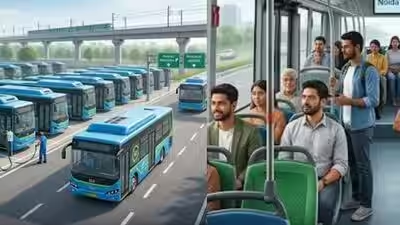
The success of the Noida Electric Bus Depot is beginning to demonstrate how the Uttar Pradesh government’s green mobility vision can move beyond policy announcements and translate into a practical, high-usage public transport network.Within less than three months of regular operations, the 100 electric buses deployed across Noida, Greater Noida and the Yamuna Authority area have already emerged as a significant new mobility option for commuters, while simultaneously creating a cleaner and more sustainable model of urban transport.The numbers tell the story. From June 20 to September 13, 2026, the e-buses collectively covered more than 15.12 lakh kilometres, carried over 7.18 lakh passengers and generated revenue exceeding Rs 2.24 crore. More importantly, the trajectory has been consistently upward, suggesting that the initial experiment is rapidly turning into a viable public transport system.The momentum became particularly visible in September. During the first 13 days of the month, the 100 buses operated for 2.96 lakh kilometres, carried more than 1.99 lakh passengers and generated over Rs 61.75 lakh in revenue.Average daily performance per bus also improved significantly over August. Daily operations increased from 190.21 kilometres per bus to 227.78 kilometres, while passengers per bus per day rose from 109.79 to 153.68. Earnings per bus per day increased from Rs 3,414.86 to Rs 4,750.20, and revenue per kilometre improved from Rs 17.95 to Rs 20.85.These figures indicate not merely the deployment of electric buses, but growing public acceptance of the service.
A three-authority model begins to take shape
The Noida Electric Bus Depot has created an interesting operational model by connecting the jurisdictions of the Noida Authority, Greater Noida Authority and Yamuna Expressway Industrial Development Authority.The 50 buses operated by the Noida Authority covered 1.50 lakh kilometres in the first 13 days of September and carried more than 1.04 lakh passengers, generating Rs 31.45 lakh. The buses recorded 231.17 kilometres per bus per day and earnings of Rs 4,839.17 per bus per day.Greater Noida’s 25 buses performed strongly on several efficiency indicators. They covered 77,110 kilometres and carried 53,194 passengers, generating Rs 16.17 lakh. At 237.26 kilometres per bus per day, Greater Noida recorded the highest daily bus utilisation among the three authorities. It also led in passengers per bus per day, revenue per kilometre and earnings per bus per day.The 25 buses operating in the Yamuna Authority area covered 68,749 kilometres and carried 42,497 passengers, generating Rs 14.11 lakh. With 211.54 kilometres per bus per day and revenue of Rs 20.54 per kilometre, the service is also showing encouraging utilisation in this rapidly developing corridor.Together, these figures suggest that electric mobility is finding a ready market in an area witnessing rapid urbanisation, industrial expansion and infrastructure development.
From public transport to green economic infrastructure
The larger significance of the initiative lies in its location. The Noida-Greater Noida-Yamuna corridor is no longer simply a collection of established urban centres. It is emerging as one of Uttar Pradesh’s important economic and infrastructure growth zones.The upcoming Jewar airport is expected to further transform this geography. As airport-linked development gathers pace, demand for dependable public transport between residential areas, commercial centres, industrial clusters, transport hubs and the airport is likely to increase. This makes the electric bus network strategically important.The Yogi government’s approach is not merely about replacing conventional buses with electric vehicles. It is about creating an integrated public transport ecosystem in which cleaner mobility becomes part of the state’s larger urban-development strategy.The Noida depot could therefore become a template for expanding electric public transport in other rapidly growing urban and industrial corridors of Uttar Pradesh.
Technology to become the next force multiplier
The next major development could be the proposed command centre in Noida for electric buses operating under all three authorities.According to UPSRTC Headquarters, a proposal has already been sent to the government for establishing a round-the-clock control room. The proposed facility would enable live monitoring of buses, routes and operations. This could potentially transform the way the network is managed.Real-time monitoring could allow authorities to track bus locations, identify delays, monitor route performance and respond more quickly to operational disruptions. Over time, data generated through such a system could also help identify high-demand corridors and passenger patterns, allowing routes and schedules to be adjusted according to actual usage.In other words, the next phase of the experiment could be not simply more buses, but smarter buses.
What could be in the offing
The strong initial response opens several possibilities for the future.First, the existing network could be expanded as passenger demand grows, particularly along corridors connecting Noida and Greater Noida with the emerging Jewar airport ecosystem.Second, greater integration between the three authorities could make inter-city and inter-authority travel more seamless. A unified operational system, common monitoring and coordinated route planning could reduce duplication and improve connectivity.Third, the proposed command centre could eventually become the technological backbone of a larger electric-bus network. Data-driven route planning, live fleet monitoring and performance analysis could help make future expansion more efficient.Fourth, electric buses could increasingly become an important component of last-mile connectivity to major transport nodes, industrial areas, educational institutions, commercial districts and new townships emerging across the NCR region.The initiative could also encourage a wider shift in public perception. When passengers experience electric buses as reliable, comfortable and economically accessible alternatives, green mobility ceases to be merely an environmental concept and becomes an everyday public-service choice.
A model with potential beyond Noida
The early performance of the Noida Electric Bus Depot offers the Yogi government an important opportunity. What began with 100 buses is showing signs of becoming a scalable model combining public transport, technology, environmental sustainability and regional connectivity.The experiment has already crossed an important threshold: passengers are using the service in growing numbers, buses are recording higher utilisation and revenues are rising.The proposed command centre could provide the next layer by bringing all three authorities onto a technology-enabled operational platform. Further expansion, particularly in the direction of Jewar airport and emerging economic centres, could potentially give the network an even larger role in the NCR’s future mobility architecture.For Uttar Pradesh, the larger message is clear. Green mobility is no longer being viewed only as a future aspiration. In Noida, it is beginning to operate on the ground, generating passengers, kilometres and revenues while creating a cleaner alternative for urban travel.The real test—and opportunity—now lies in scaling this success. If the momentum continues, the Noida model could evolve from a 100-bus experiment into a much larger, integrated electric mobility network, reinforcing the Yogi government’s vision of a cleaner, smarter and better-connected Uttar Pradesh.