









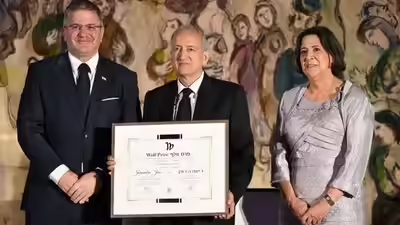
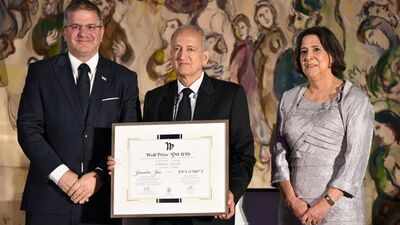
MUMBAI: For nearly four decades, physicists across the world have relied on a deceptively simple idea proposed by an Indian scientist to explain one of the strangest behaviours ever observed in the quantum world. This week, that insight earned Prof. Jainendra K. Jain one of the highest honours in science.On June 18, at a ceremony in Jerusalem, Prof. Jain received the Wolf Prize in Physics, becoming the first person of Indian origin to be awarded the distinction. Presented by Israeli President Isaac Herzog at the Knesset, the prize recognises his discovery of composite fermions — a breakthrough that transformed the understanding of the fractional quantum Hall effect and reshaped modern condensed matter physics.The Wolf Prize, awarded since 1978, is regarded as one of the world’s most prestigious scientific honours. Twenty-seven of its previous physics laureates have gone on to receive the Nobel Prize.Yet the story of Prof. Jain’s achievement begins far from the world’s great laboratories.He grew up in Sambhar, a small town on the edge of Rajasthan‘s Thar Desert, where a fascination with physics took root early. As a child, he encountered the story of Indian physicist Satyendra Nath Bose and his correspondence with Albert Einstein in a children’s magazine. The idea that someone from India could contribute to humanity’s understanding of the universe stayed with him.Life, however, intervened in ways no child could anticipate.At the age of twelve, while visiting Kolkata with his family, a tram collided with their car. His mother never regained consciousness. Jain suffered devastating injuries that left him permanently disabled. Returning home months later on crutches, the future he had imagined seemed uncertain.A turning point came through the Jaipur Foot, the low-cost prosthetic developed by Dr. P.K. Sethi and craftsman Ram Chandra Sharma. It allowed him to walk again, continue his education and pursue the dream that had sustained him through recovery.The journey that followed took him from Maharaja College in Jaipur to IIT Kanpur, then to Stony Brook University in New York for doctoral studies. When he boarded a flight to the United States in 1981, it was the first time he had ever travelled by air.Eight years later, as a young postdoctoral researcher at Yale University, Jain found himself grappling with one of the most perplexing puzzles in physics. Experiments had shown that electrons confined to ultra-thin layers and subjected to intense magnetic fields behaved in ways that existing theories could not explain. Their conductivity appeared in precise fractional values that seemed almost impossible.The solution arrived unexpectedly.During a television commercial break, Jain began doodling. Somewhere in those sketches emerged a radically new way of looking at the problem. Electrons, he realised, could bind with tiny quantum vortices to form entirely new entities. He called them composite fermions.The idea, published in Physical Review Letters in 1989, brought order to a bewildering phenomenon. What had appeared mysterious suddenly became comprehensible. The mathematical patterns predicted by his theory — now known as Jain sequences — were subsequently confirmed through experiments and became foundational to the field.Today, composite fermions occupy a central place in quantum physics. They have revealed previously unknown states of matter and opened pathways to research in topological quantum computing, where scientists hope to build quantum systems inherently resistant to errors.Reflecting on the honour, Prof. Jain described the award as both humbling and deeply personal.“Physics has given me far more than I could ever have imagined when I began this journey as a young boy growing up in rural Rajasthan,” he said. “The opportunity to spend a lifetime trying to understand nature is a privilege beyond measure.”Now serving as Evan Pugh University Professor and Eberly Family Chair in Physics at Pennsylvania State University, and as the founding director of the Lodha Theoretical Physics Institute, Jain has authored more than 250 scientific papers and a seminal monograph on composite fermions. He is a member of the US National Academy of Sciences, the American Academy of Arts and Sciences and the Indian National Science Academy, among many other distinctions.But perhaps what makes this recognition resonate beyond the scientific community is the journey itself.The Wolf Prize honours a discovery that changed physics. Yet behind the equations lies another story: of a boy from a desert town, a life-altering tragedy, a prosthetic that restored possibility, and a curiosity about nature that never dimmed.In celebrating Jainendra Jain, the scientific world is recognising not only a profound intellectual achievement, but also a remarkable testament to resilience, imagination and the enduring power of human inquiry.