








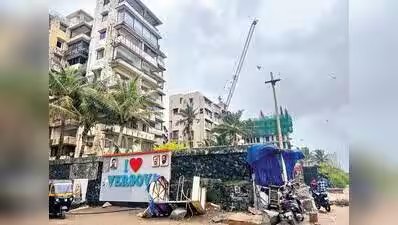
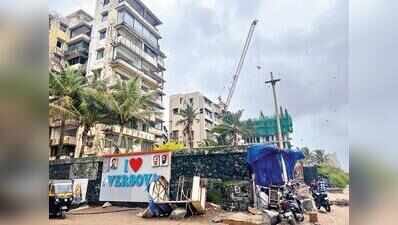
Mumbai: Once a quiet fishing village of shorefront bungalows, Versova, with its low-rise, middle-class housing societies that rose in the 1980s and 1990s, is now becoming a skyscraper enclave for the ultra-rich.Along a 2km stretch from J P Road — running from Seven Bungalows bus depot to Yari Road bus depot— as many as 26 housing societies have signed redevelopment deals with some of Mumbai’s biggest builders.Many of these plots are close to the beach, and some directly touch the sea. Where four- to-seven storey buildings once defined the horizon, 25- to 35-storey luxury towers are planned. Local property dealers say they expect over 3,600 new apartments in the free sale component to flood the market in the next five years in this locality. “This translates to a huge inventory build-up of at least 120 months,’’ one of them said.The numbers reveal the scale. According to data collated from local sources, sea-facing societies/plots are expected to add about 10 lakh sq ft of RERA carpet area for sale. Existing members in these sea-touching societies are being offered extra area in the range of 50% to 70% — a 700 sq ft home can become 1,110 to 1,200 sq ft — along with corpus payments ranging from Rs 2,500 to Rs 6,000 per sq ft.In the non-sea-facing category, around 3,000 flats are in the pipeline, with about 45 lakh sq ft of RERA carpet area for sale. Here, extra area offers range from 33% to 53%, and corpus typically falls between Rs 2,500 and Rs 4,000 per sq ft.This is only the first wave. At least another 25 societies — comprising around 30 to 35 buildings — are up for redevelopment and are currently in tendering.For existing residents, the redevelopment pitch arrives wrapped in aspiration: larger homes, new amenities, modern lobbies, mechanised parking, branded finishes. But beneath the shine is a fear that Versova is building towers without building the infrastructure to support them.Architect and Versova resident Sanjeev Punjabi, argues that the area’s biggest threat is not merely vertical growth, but the sudden surge of vehicles and services it will trigger.With new links planned to improve connectivity — projects like the Coastal Road extension towards Lokhandwala Complex and further to Malad North, and the Bandra-Versova Sea Link — Punjabi warns that better access could become an “undoing” if Versova’s internal roads and junctions remain unchanged. “Thousands of cars will ply,” he cautions, shifting congestion to choke points like the Versova junction. The glamour of “Italian marble in the lobby”, he says, distracts from fundamental questions: sanitation capacity, water supply, parking spill over, and what happens once you enter Versova’s narrow street grid.Dhaval Shah of the Lokhandwala Oshiwara Citizens Association traces the construction boom to the last three years and predicts a branding shift: “Versova will be the new Bandra.” His warning is not about status but preparedness. Luxury sea-facing apartments in the new towers are commanding around Rs 1 lakh per sq ft, yet the neighbourhood, he argues, is not being upgraded in proportion to the price tags. The fear is that a premium skyline will sit on top of overstretched civic systems.Punjabi warns about towers rising above the tree canopy, leaving fewer setbacks and less open breathing space. More podiums and basements are being planned, and mechanised parking systems are becoming standard — solutions on paper that can create new choke points at entry ramps, and new maintenance headaches once societies take over.Developer Vishal Ratanghayra of Platinum Corp, who is redeveloping a Versova society, said authorities will be required to gear up the social infrastructure and civic infrastructure like healthcare, sewerage, drainage, and utilities. “Not achieving this and coupled with rapid redevelopment will lead to traffic jams, water shortages and overwhelmed sanitation systems in Versova and in surrounding areas,’’ he said.Versova’s transformation also carries a quieter loss: the thinning of memory. The area’s identity is still tied, in popular language, to Seven Bungalows — yet none of the original seven bungalows remain. They were built after the plague hit the city in 1896, when wealthy families sought a calmer edge outside the dense core. An INTACH report records their names — Talati Bungalow, Kaikei Villa, Rus Cottage, Jasbir Villa, Gulistaan, Vijay Bhawan and Shanti Niwas — and the constellation of owners that included the Maharaja of Gwalior, the Maharaja of Kutch, Dadabhai Naoroji, scholar Rustom Masani, Sorabji Talati, and families such as the Chinais and Khambattas. Coconut palms, sea and sand framed those homes. Today, the names survive largely as a label on bus depots and real estate listings.