









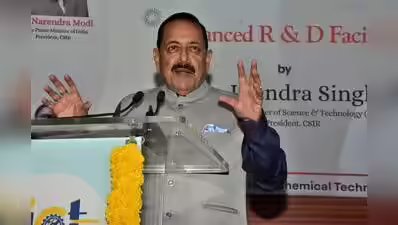
Hyderabad: Union minister of state (Independent Charge) for Science and Technology Dr Jitendra Singh said that research is moving beyond crop improvement to developing technologies that convert agricultural waste and residues into value-added products, creating new opportunities for farmers, MSMEs and startups, at the CSIR–Indian Institute of Chemical Technology (CSIR-IICT), Tarnaka, on Tuesday.Addressing scientists, the minister said that stronger partnerships between agricultural research and industry would drive India’s next phase of economic growth by translating scientific innovation into practical and commercial use. “India is steadily moving from being a technology adopter to becoming a technology developer, with science playing a key role in economic growth, self-reliance and global competitiveness,” Dr Singh added.He also inaugurated four advanced research and development facilities at the IICT and laid the foundation stone for a ₹44.4 crore 200-student hostel complex to improve residential facilities for research scholars.Among the facilities are an advanced R&D facility for fluorochemicals, a 500 KLD decentralised effluent treatment plant for the Siripuram handloom cluster, a continuous processing platform for industrial chemicals and the Sustainable Engineering Complex (SustEC).On CSIR, the minister highlighted that it has consistently shown how scientific research can address national priorities while providing practical solutions for industry and society. Referring to technologies developed by CSIR for producing compressed biogas from food and agricultural waste and converting captured carbon dioxide into dimethyl ether, he said these innovations reflect India’s growing focus on clean energy, the circular economy and converting waste into valuable resources. Such technologies, he added, strengthen energy security while opening new opportunities for industrial growth and environmental sustainability.“The fluorochemicals facility will strengthen India’s capabilities in pharmaceuticals, agrochemicals, speciality chemicals, electronics and defence while reducing dependence on imports. The other facilities, he said, would promote clean manufacturing, waste-to-wealth technologies and sustainable industrial processes,” Dr Singh added.