






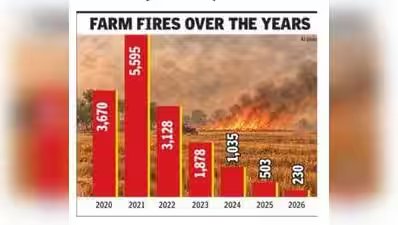
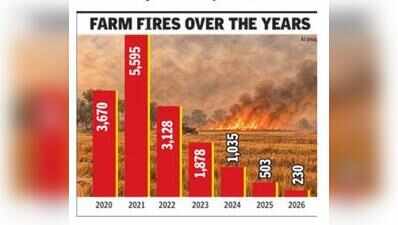
Gurgaon: Haryana recorded 230 paddy-residue burning incidents between Sept 15 and Nov 14. The farm fire count was less than half of the 503 incidents recorded during the corresponding period in 2025 — posting a 54% decline. The 2026 count is the lowest in seven years: 1,035 incidents in 2024, 1,878 in 2023, 3,128 in 2022, 5,595 in 2021 and 3,670 in 2020. The city — besides Charkhi Dadri, Mahendragarh, Mewat and Rewari — reported zero incidents.The season’s biggest spike came on Diwali, Nov 8, when 80 farm fires were detected in a single day. However, the surge proved short-lived, with incidents dropping sharply over the following days, according to the latest monitoring data. The Nov 8 tally accounted for nearly 35% of the season’s total of 230. The daily count fell to 17 on Nov 9 and 14 on Nov 10. It declined to eight on Nov 11 and four on Nov 12, before rising to 11 on Nov 13 and dropping to just one on Nov 14.However, the district-wise distribution shows that farm fires remain concentrated in a handful of agricultural districts. Kaithal recorded the highest number at 68, accounting for nearly 30% of the state’s total. Jind followed with 31 incidents, Karnal with 23 and Kurukshetra with 19. Together, these four districts accounted for 141 incidents, or over 61% of the state’s total.Some districts also recorded an increase over last year despite the overall decline. Kaithal reported 68 incidents against 59 in 2025. Karnal’s count increased from 18 to 23, Kurukshetra’s from eight to 19 and Palwal’s from 13 to 17. In contrast, Fatehabad recorded 13 incidents against 78 last year, while Jind reported 31 against 143. Hisar’s count fell from 21 to nine and Sonipat’s from 41 to nine.Every year, Delhi-NCR witnesses heavy smog and deterioration of air quality levels during winter. The Graded Response Action Plan (GRAP) is implemented every year as a result, with measures including banning diesel gensets, mechanised cleaning and sprinkling of water on roads, and closing down brick kilns, hot-mix plants, stone crushers or any other factory that pushes up air pollution levels. According to the annual Air Quality Life Index report of 2021 by the Energy Policy Institute of the University of Chicago, residents of the city lose around 9.9 years of life expectancy due to pollution.Across the seven states and regions monitored by ICAR-IARI, 11,725 paddy-residue burning incidents were detected between Sept 15 and Nov 14. Punjab accounted for the highest number at 5,835, followed by Madhya Pradesh (3,020), Rajasthan (1,474) and Uttar Pradesh (948). Haryana’s 230 incidents were lower than these four states but marginally higher than Uttarakhand’s 216. Delhi recorded two incidents during the period.A survey by Council on Energy, Environment and Water (CEEW) points to growing adoption of alternatives to stubble burning, but also highlights the economic challenges farmers face in managing paddy residue. The survey, conducted between Jan and March 2026 among 1,588 landowning farmers across 144 villages in 12 Haryana districts, found that 39% of respondents used paddy straw as fodder, 38% relied on baling and 32% used in-situ machinery-based management.However, the economics of residue management remains a concern. Among farmers using baling, only 7% said they received payment from buyers for their straw, while 62% gave it away without payment. Another 31% said they paid around Rs 1,000 per acre to get the straw cleared from their fields. The cost of using machinery for in-situ management can also be significant, with a Super Seeder costing farmers around Rs 4,000-4,500 per acre, according to the CEEW findings.