









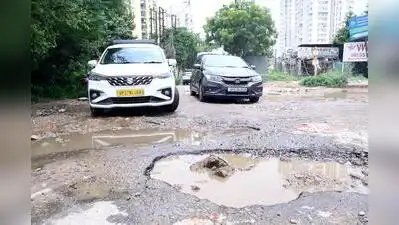
Ghaziabad: To enable better tracking and quicker repairs, Ghaziabad Municipal Corporation will assign unique identification numbers and health grades to the city’s 2,000-km road network. The unique ID system will create a digital record of past work done on each stretch, allowing an easy access to repair history. This is the first time in the state that such IDs are being assigned to roads.The civic body has already surveyed more than 119 km, with the exercise continuing in phases. “The city has a road network of 2152 km. This includes main roads, arterial roads and even bylanes. We will be assigning IDs and grades to them,” municipal commissioner Vikramaditya Singh Malik said.He said multiple agencies across six zones are involved in the construction and maintenance of the network. At times, it becomes difficult to track down the problem areas. Moreover, repairs get delayed due to multiple factors such as surveys, tendering process, weather and GRAP restrictions. “The IDs will help us to reduce human intervention and for better coordination and monitoring. They will make tracking easy, follow-up better and intervention targeted,” he said.The codes will help keep records of when each road was constructed, the area where it is and the contractor who did the work.Depending on the quality of the roads, grades like good, fair, poor and very poor will be assigned to road stretches. “The grading system will help ascertain the road health in the quickest time,” he said.The survey is part of GMC’s annual initiative to curb air pollution. The civic body had earlier identified at least half a dozen dust bowl points across the city. The officials hope that the digital records will help them identify the stretches that need immediate intervention before the onset of winter.Malik on Tuesday attended a meeting arranged by the ministry of housing and urban affairs on civic conditions. GMC had earlier requested Rs 900 crore from the finance ministry for air pollution abatement in FY 2026-27. Officials said the corporation had sought the amount to check dust pollution by laying interlocking tiles by the roadside.Among the NCAP cities in 2025 Ghaziabad had presented a very bleak picture. Delhi was the most polluted city in the country with an annual average PM10 concentration of 197 µg/m³ and Ghaziabad was a close second with annual average PM10 concentration of 190 µg/m³. It exceeded the national ambient air quality standards for 285 days in 2025. Air quality was of particular concern, with the city having 22 days of ‘severe’ air, the highest among all Indian cities.On PM2.5 parameters, Ghaziabad was among the top three most polluted cities in the country, along with Byrnihat in Meghalaya and Delhi. The annual average PM2.5 concentration in Ghaziabad in 2025 was recorded at 93 µg/m³.