




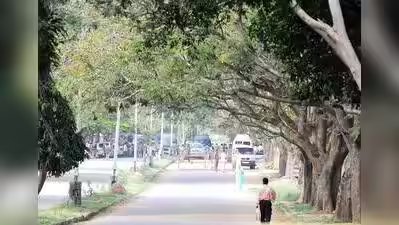
Bengaluru: The city’s tree management system could soon receive a major technological upgrade, with the Greater Bengaluru Authority’s (GBA) forest wing planning to collaborate with the Institute of Wood Science and Technology (IWST) to assess the health of trees using advanced diagnostic tools.At present, assessments rely largely on visual inspections by forest officials and field staff, who look for signs such as decay, structural weakness, leaning trunks and dead branches before recommending pruning or removal. However, officials say many internal defects in trunks and root systems remain undetected through visual checks alone, highlighting the need for more accurate, technology-based assessments.Sudarshan GK, deputy conservator of forests (GBA), said: “We identified and removed over 1,000 hazardous trees before monsoon. These advanced technologies for assessing tree health will be a valuable addition. Going forward, it would be ideal for civic bodies to have such equipment to scientifically monitor and maintain Bengaluru’s urban greenery.”How does it workIWST has proposed a science-based tree risk assessment framework for all five corporations. It envisages conducting Visual Tree Assessments (VTA) of 300 priority roadside trees in each corporation, followed by advanced diagnostic testing for trees identified as medium or high risk.At the heart of the proposal is sonic tomography, a non-invasive technology often described as a health scan for trees. The system works by placing sensors around a tree trunk and transmitting sound waves through the wood. By analysing how quickly the sound travels through different parts of the trunk, experts can detect internal decay, hollowness, cracks and structural weaknesses that may not be visible externally. The technology helps determine whether a tree is healthy, requires treatment, pruning or, in extreme cases, removal.Ageing canopyIn a study conducted by IWST on 454 roadside trees in Malleswaram found that 223 trees—nearly 49%—were unhealthy and showed structural defects. Many belonged to ageing species such as Gulmohar, Copper Pod, African Tulip and Rain Tree, making them increasingly susceptible to strong winds and heavy rain.The assessment also detected internal hollowness of 10% to 80% in several high-risk trees, underscoring the limitations of visual inspections. Decay, fungal infections, root damage and structural weaknesses often remain hidden until trees fail during extreme weather.Rs 4-crore planThe project proposes ward-wise geo-tagged tree risk registers, species-specific risk profiles and standard operating procedures for management. It also includes training 10–15 staff members in each city corporation in scientific assessment to support informed decisions on tree retention, pruning and removal.IWST has estimated the project cost at Rs 4.4 crore for implementation across the corporations. The budget covers scientific equipment, manpower, field surveys, training, public awareness and institutional expenses.Officials say the collaboration could pave the way for Bengaluru’s first large-scale, technology-driven tree health monitoring programme, shifting tree management from reactive inspections to a scientific, data-driven approach that enhances public safety while preserving the city’s green cover.“With Bengaluru’s growing population of large, mature urban trees, there is an urgent need to integrate advanced non-invasive diagnostic technologies into urban tree management, enabling scientific assessment of tree health, structural stability and risk, while prioritising the preservation and protection of these invaluable green assets for future generations,” said Dr A Muthu Kumar, Scientist – F, head – forest protection division, ICFRE – Institute of Wood Science and Technology.