






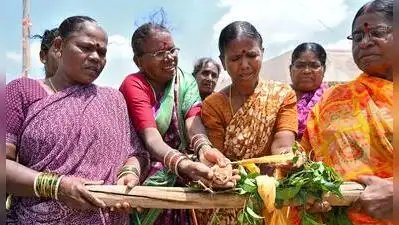
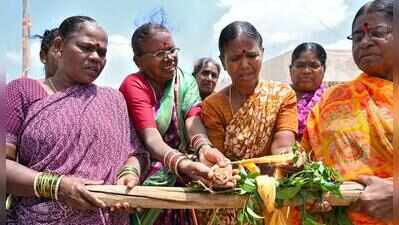
Nednur (Rangareddy): As Telangana stares at the rain deficit, scenes thought to have faded into history are returning to its villages. Barely 48 km from Hyderabad‘s gleaming IT hubs, women in Nednur village of Rangareddy district are once again carrying decorated frogs in bamboo baskets, reviving ‘kappa aata‘ (frog dance) — an age-old rain-invoking ritual abandoned during years of reliable monsoons but now resurrected amid fears of a failed kharif season.Similar scenes are unfolding across the state, with communities turning to traditional practices such as ‘Varadapasham‘ and ‘Vanavasam‘ as erratic monsoon conditions leave fields parched and agricultural activity in limbo.When TOI visited Nednur in Kandukur mandal, the narrow lanes of the rain-fed village echoed with chants of ‘Vaana Devuda‘, a fervent appeal to Lord Varuna, the rain god. Groups of women, many left without work as sowing activities remain stalled, moved from house to house carrying frogs adorned with turmeric and kumkum (vermilion) in bamboo baskets.As the procession wound through the village, anxious farmers watched with hope. Agriculture in Nednur depends entirely on the monsoon, and the delayed rains have brought farming operations to a standstill. Maize, the village‘s principal crop, remains unsown across large stretches of farmland.Rooted in the belief that frogs serve as messengers to the rain gods, kappa aata was once commonly performed across Telangana during prolonged dry spells. Villagers place frogs on bamboo frames, sprinkle water on them to induce croaking, and collect rice and other essentials for a community feast.The scenes evoke memories of 2016, when recurring droughts and severe rainfall deficits forced communities across Telangana to organise similar prayers. In the decade since, favourable monsoons had largely pushed such traditions into the background.“We learnt these traditions from our grandmothers. There was no need to perform them over the past decade. Now, we are once again invoking the rain god,” said Anjamma, one of the participants.“We are witnessing a situation like this after a decade. We never had to pray to the rain god as he was kind to us. If rains do not arrive within the next week, it will be a huge loss for us,” said Mutyal Reddy, a farmer.Anxiety is palpable among villagers. “I have two acres of land, but we are unable to cultivate anything because of the lack of rain. There is no work for us. The govt should come to our rescue and compensate us for whatever agricultural work has already been done,” another villager said.The revival of these rain rituals comes as Telangana grapples with a significant seasonal rainfall deficit, with several districts receiving far below normal precipitation. In parts of Rangareddy district, the shortfall has crossed 60%, delaying sowing operations and raising concerns over the kharif crop.Meteorologists attribute the dry spell to the absence of active low pressure systems over the Bay of Bengal, leaving Telangana in a temporary rain-shadow zone even as neighbouring states receive substantial rainfall.The return of these traditions is not limited to Nednur. Villagers in parts of Jangaon, Jagtial and Karimnagar districts have also revived kappa aata. In Mulugu, communities have turned to Varadapasham, a ritual in which sweet rice is offered on sacred rocks and then consumed without using hands as a gesture of humility before the rain gods.In Suryapet district, entire villages have reportedly participated in Vanavasam, a community prayer in which residents gather in nearby forests, seek divine intervention for rain, and share a communal meal — a reflection of both faith and growing anxiety over an increasingly uncertain monsoon.