







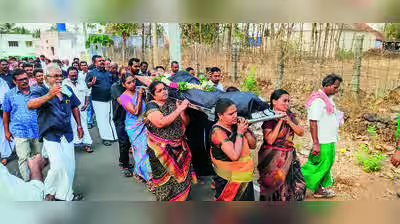
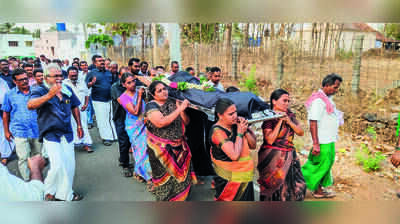
When Saraswathi R first carried a body all the way to the cremation ground, relatives scolded her, villagers asked why she was doing it. “I asked them why only men were allowed to do it.” Twenty-five years later, says Saraswathi, some of those who questioned her, have joined her in helping families conduct the last rites for their loved ones.The 50-year-old is part of the women’s wing of the Dravidar Viduthalai Kazhagam (DVK), a social justice organisation based in Salem, which conducts funerals to challenge patriarchal traditions that reserve death rituals for men, assert equal rights, and dismantle caste-based and religious superstitions surrounding death. The collective is inspired by the ideals of rationalist leader Periyar E V Ramasamy that women should have an equal role in honouring the dead, regardless of gender, caste or religion.“Periyar believed women had the same rights as men,” says Saraswathi. “Dravidar Kazhagam started a movement like this in 1980, where women took charge of funerals in Trichy. We started this initiative in Salem in 2010 and have taken it to other districts.”There are more than 300 members in Salem, with many involved in districts including Erode, Tirupur and Dharmapuri. Some are homemakers, others govt employees, tailors, entrepreneurs and teachers. “They take time off to spread awareness in villages. Owing to their awareness programmes, more and more young women are joining us,” says Saraswathi.When a family needs help, the women members arrive at the house, dressed in black sarees, carry the body to the burial ground, chant tributes (such as veera vanakkam or salute to the brave), lower the bodies into the grave and throw soil on the body themselves. “We don’t follow any superstitions or religious rituals,” says Saraswathi. “There are no flowers, lamps, camphor, burning cow dung cakes, coins placed on the forehead of the deceased or pictures of gods.” The act, she says, goes beyond performing funeral duties. It challenges customs that restrict women’s participation in death rituals.But it comes with a heavy cost. Sudha O, head of the organisation in Salem, says her father hasn’t spoken to her in years. A religious man, he refuses to accept the work she does. “Sometimes, he talks to my children, never to me,” she says. “But I find purpose in my work, so I go on, and boldly so.”R Jothimani from Chennimalai in Erode says people curse at her for carrying a body. “They would say, ‘These black shirt people (Periyarists) have no other work,’” says the 41-year-old. “I never get angry. I just try and explain what we are trying to achieve. Some eventually come around.”Sudha says when they cremated the father of a fellow activist, some villagers said his head would explode and that the women involved in the burial would face dire consequences. But we stood by the pyre and saw it through,” says Saraswathi.During funerals, says Sudha, women are traditionally not allowed to go to the burial ground. “Lighting the funeral pyre and performing the last rites are considered the sons’ responsibility. People believe that if women perform them, the dead will not attain salvation. We want to break these superstitions,” she says.Sivakami V from Tirupur had heard of the work the women’s wing was doing in her village, and though she admired Periyar, she never thought of joining the initiative. “But then I saw my friend fight against opposition from villagers and light her husband’s pyre. Her relatives cursed her. They said that only a man could light the pyre. The fight went on for long but she stood her ground. It made me want to help other families in similar situations,” says Sivakami.Patriarchy isn’t the only barrier they are fighting against. “We want people to shed rites based on caste. For instance, one ritual dictates in which direction a body is placed in the house depending on caste. We conduct funerals of people in the village irrespective of caste and bury or cremate them as per their families’ wishes,” says Jothimani. “When we enter a house we never consider the caste or religion of its residents.”Sudha adds that the women’s wing also approaches schools and colleges, and conducts talks in community halls and public spaces in towns and villages. “Many women and college students are joining the initiative. Some return to their villages and start such services.”