









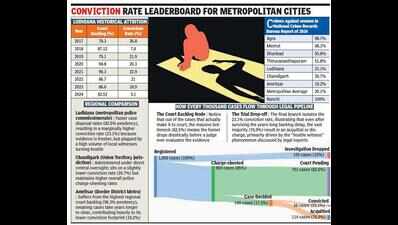
Ludhiana: The city is clearing its cases of violence against women at a six-year high, yet nearly 80% of the alleged perpetrators still walk free due to witness intimidation and poor policing.Latest data from the National Crime Records Bureau (NCRB) reveals the industrial hub secured convictions in just 23.1% of crimes against women in 2024. While the figure represents a stark improvement from 18.9% the previous year, it means nearly four out of five prosecutions still fail to result in a guilty verdict.Legal experts warn a breakdown in police investigations and widespread witness intimidation continue to sabotage justice, even as courts speed up their case processing times.Ludhiana rose to 10th out of 34 major Indian metropolitan areas for its conviction rate. Ranchi topped the national list with a 100% conviction rate, followed closely by Agra, while Raipur ranked lowest at a negligible 1.1%. Regionally, Ludhiana outperformed its neighbours, sitting ahead of Chandigarh and Amritsar.The marginal uptick in convictions coincided with a sharper turnaround in the courtroom. Ludhiana logged an 82.5% case pendency rate in 2024 — its second-lowest backlog since 2019 and a notable drop from the pandemic-era peak of 94.8% in 2020.The quicker disposal of cases allowed Ludhiana to beat out Amritsar (90.3% backlog) and Chandigarh (87.9% backlog) for regional efficiency. Nationally, however, the city ranked 30th out of 34 metro areas for delays, far behind Prayagraj, where a staggering 98.5% of cases remain stalled in the legal system.Prominent local advocate Yogesh Khanna welcomed the marginal progress but warned against premature celebration, branding the 23.1% conviction rate “very low” for violence against women.“In too many of these serious matters, prosecution witnesses turn hostile and investigations by agencies concerned lack proper depth,” Khanna said. “Furthermore, a court backlog of 82% is still entirely unacceptable. For cases of this gravity, we need to drive that pendency rate down to at least 50%.”Khanna credited the slight upward trend to shifting cultural dynamics and modern public visibility.“There is a gradual increase in accountability because public awareness is growing,” Khanna said. “Social media has amplified the demand for justice, which is starting to apply pressure where it is needed most.”When the system holds, the penalties are severe. In April 2024, a Ludhiana local court sentenced a man to 20 years of rigorous imprisonment for the sexual assault of a 16-year-old girl. The conviction came nearly two years after Daresi police first booked the offender under India’s Penal Code and the Protection of Children from Sexual Offences Act — a rare closure in a system where the vast majority of survivors are left waiting.