








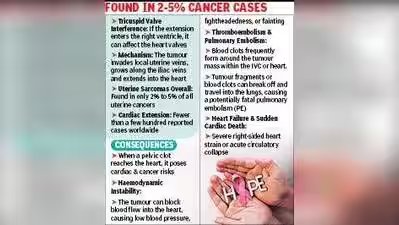
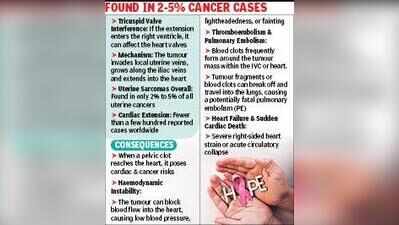
Kolkata: In a first-of-its-kind surgery performed in eastern India recently, doctors removed a blood clot (thrombus) that had travelled from a tumour in the uterus to the heart of a 38-year-old woman from North 24 Parganas. The surgery was undertaken at a city hospital.The woman was suffering from a rare condition, termed ‘uterine sarcoma extending into the heart’, which affects barely 1% of the gynaecological patients around the world. Doctors said the condition was extremely rare, representing only 2% to 5% of all uterine cancers.As the thrombus moved to the heart, it was even rarer a condition with fewer than a few hundred reported cases worldwide in medical literature. It involved a double procedure, including an open-heart surgery and a laparoscopic procedure to remove the uterine tumour. Both the clot and the tumour had cancerous cells. The woman was admitted to the hospital with severe stomach pain on Aug 11. After the surgery on Aug 11 at Narayana RN Tagore Hospital, the woman’s body is now free of cancer cells.She was discharged from the hospital on Aug 18. “We conducted a series of tests which revealed a tumour, but the worrying part was that it was not only cancerous but a clot from the growth that had travelled to her heart. It threatened to block one of her cardiac arteries which could have been fatal,” said Upasana Palo, consultant gynaecology and robotic surgeon at RN Tagore, who conducted the surgery. The woman’s uterine tumour or uterine/pelvic sarcoma measured 16.2 cm. A clot from it, or a tumour thrombus, travelled through the abdominal veins and inferior vena cava and extended into the right atrium of the heart.Palo explained that the surgery had to be performed with the combined efforts of teams from gynaecologic oncology, cardiothoracic and vascular surgery, along with cardiac anaesthesia and critical-care departments, making it a unique operation.The tumour typically invades local uterine veins, grows continuously along the iliac veins into the inferior vena cava (IVC), and eventually extends directly into the right atrium of the heart. “It was important to extract the clot since it could physically block blood flow into the heart, causing low blood pressure, lightheadedness, or fainting (syncope). If the extension enters the right ventricle, it can damage or obstruct the heart valves,” explained Palo.