








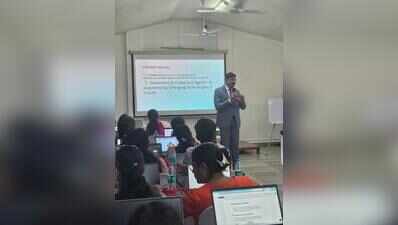
Pune: City schools are exploring different ways to integrate artificial intelligence into everyday teaching, from using AI to break down complicated concepts to making learning fun and preparing syllabi.Some schools are fostering responsible use of AI among students, while others are training teachers to use it for lesson-planning, assessment, and personalised learning.“AI is an assistive technology that complements teachers’ expertise and strengthens student agency,” said Jayanta Kar, head of design and technology and computer science at Victorious Kidss Educares (VKE). As part of the school’s International Baccalaureate (IB) approach, which emphasises critical thinking, scientific inquiry and academic integrity, students are encouraged to use AI to brainstorm, proofread and understand difficult concepts while verifying AI-generated information.The school uses tools such as Google’s Gemini and NotebookLM for teaching, Toddle to monitor learning, Turnitin to check for plagiarism and AI-generated content, and AssessPrep for evaluation. The school also uses Arduino-based robotics activities and digital platforms such as Tinkercad to help students learn programming, electronics, mechanical systems and hands-on problem-solving.Vidya Valley School is focusing on responsible use of AI among teachers before rolling it out in classrooms. The school recently organised a three-day AI workshop for teachers.The school’s director Ipsita Rodricks said the workshop explored how AI could help prepare personalised lesson plans, generate assessments, simplify research and support students with different learning needs. The workshop also addressed concerns around plagiarism, misinformation, student data privacy and the risk of AI becoming a crutch for students.Rodricks said AI could help reduce repetitive paperwork and preparation, giving teachers more time for classroom interaction and individual student support.At SNBP International School, AI is being used to prepare teaching presentations, worksheets and question papers with varying levels of difficulty. “Instead of preparing one worksheet for every learner, teachers are using AI to generate questions at different levels of complexity. A basic set can reinforce foundational concepts, while another can encourage application, analysis and higher-order thinking,” director-principal Jayshree Venkatraman said.The school is also using AI to convert poems into songs to make language-learning more engaging. “AI-assisted analysis can also help teachers identify patterns in student responses and recognise areas of improvement. If a significant number of students performed poorly on a particular concept, the teacher can identify it as a potential learning gap,” she said.Venkatraman said the analysis could help teachers revisit difficult concepts, redesign classroom activities and provide targeted practice to students who need additional support, while offering enrichment opportunities to those ready for greater challenges.