






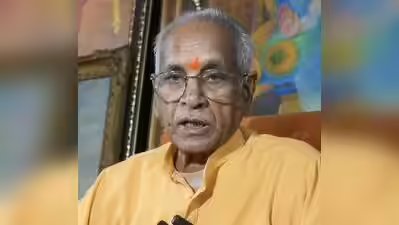
Ayodhya: Ram ne lagaya hai, Ram hi mitayenge.With the belief that Lord Ram will clear his name, former Ram Temple Trust general secretary Champat Rai has largely withdrawn from public life over the past month.Having supervised arrangements for the flag-hoisting ceremony atop the Sheshavatar Temple in the Ram Temple complex, Champat Rai was last seen publicly on June 23. Since the following day, he has remained largely confined to Teerth Kshetra Bhawan, a three-storey building located barely 200 metres from the temple complex.For the 80-year-old, who until recently walked 10-12km daily while interacting with 200 to 250 people, books have become a refuge from the monotony of seclusion. At the centre of a controversy since Samajwadi Party chief Akhilesh Yadav raised the alleged ‘chanda chori’ (donation theft) issue on social media on June 7, Rai has remained largely out of sight. Since then, he has issued only two written statements on the matter.He is also said to be staying away from reading newspapers or watching news channels.Rai had resigned from the post of the Ram Temple Trust’s general secretary in June last week on moral grounds.Since becoming active in Ayodhya in 1991, the senior VHP functionary had been residing at Bharat Kuti — his camp office-cum-residence in Karsewakpuram in Ayodhya. However, as supporters, Temple Trust employees and journalists increasingly gathered there either to express solidarity or seek answers after the controversy erupted, Rai reportedly decided to move to Teerth Kshetra Bhawan, which offered greater privacy and security.Those close to him say his routine has changed dramatically. Rai now spends most of his time inside a modest 450 square feet first-floor unit resembling a compact one-bedroom apartment. He is occasionally seen on the terrace. His day begins between 5am and 6am and follows a disciplined schedule. Known for drinking only lukewarm water throughout the year regardless of the weather, he continues the habit, with staff regularly refilling his thermos.Until June 23, Rai rarely retired before midnight and had little personal time. “These days, he spends much of his time revisiting religious texts, autobiographies of people he admires and works of Hindi literature,” said a long-time associate who has worked with him for over two decades.Contrary to his public image, several associates describe Rai as deeply respected among those who have worked closely with him. This correspondent spoke to supporters ranging in the 25 to 75 age group, many of whom continue to stand firmly by him.“He may be perceived as authoritative, arrogant or even dictatorial by some, but those who have seen him work on the ground understand the role he played in the Ram Temple movement and in advancing the causes of the RSS and VHP,” said another associate. He added that Rai harbours no resentment towards fellow Trust members and has accepted the situation with equanimity. “He has left everything to fate and continues to follow his altered routine,” he said.Almost every day, Rai takes a 30-minute walk on the terrace during the early morning or after sunset. Unable to visit the Ram Temple, he regularly offers prayers from a distance, bowing towards the shikhar above the sanctum sanctorum.His dietary habits remain unchanged. He generally consumes no more than three chapatis with vegetables or dal and drinks two to three cups of tea a day without snacks. Despite his self-imposed isolation, around 20 to 25 visitors continue to meet him daily.Among them are interim Trust general secretary Krishna Mohan, treasurer Swami Govind Dev Giri, prominent saints, senior RSS and VHP functionaries, politicians, MPs, MLAs, bureaucrats, trust employees, traders, local residents and long-time associates.However, from July 25 onwards, the number of visitors is expected to decline sharply. Rai has resolved to undertake a month-long Ramcharitmanas Parayan and plans to observe maun (silence) until late afternoon every day during the period.Not everyone is sympathetic. A section of observers believes Rai must be held accountable irrespective of his standing within the temple movement.“The money allegedly stolen belonged to devotees who trusted the system. Given the extent of control Rai exercised over temple affairs, he must answer questions about what happened. Accountability cannot be avoided merely because some people continue to support him,” said Lucknow-based advocate Pranshu Agrawal.Soon after Akhilesh Yadav’s June 7 post, Rai issued a statement asserting that audits jointly conducted by the Trust and the State Bank of India had not revealed any significant irregularities in the cash-counting process. A month later, after the Trust accepted his resignation at its July 6 meeting, Rai issued a second handwritten note, saying he would respond to all allegations once the Special Investigation Team completed its inquiry.In the meantime, accusations concerning both his professional and personal conduct continued to surface. Constantly pursued by television crews during his commute between Karsewakpuram and the Ram Temple, Rai ultimately chose to remain indoors until the three-member SIT submits its final report.For now, the man who once occupied the centre stage of Ayodhya’s temple administration spends his days in relative isolation — reading, praying and waiting for what he believes will be his vindication.