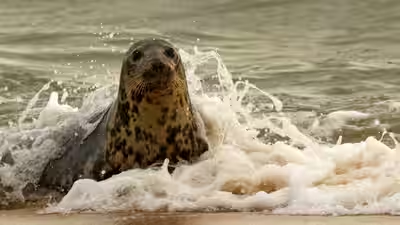







How an eel elevator on Maine’s Penobscot River helped restore millions of fish and brought humpback whales back |

Every spring, millions of migratory fish leave the Atlantic Ocean and swim into freshwater rivers to reproduce, continuing journeys that have existed for thousands of years. On Maine’s Penobscot River, however, hydroelectric dams blocked many of these ancient migrations for more than a century, causing dramatic declines in species such as American shad, river herring,…

Read More

In 2006, a tiny deep-reef fish was pulled from deep water off South Australia and misidentified; nearly 20 years later, scientists recognised a new species

Image Credit: Journal of Lost Species Some discoveries happen the moment a specimen is collected. Others take years. In this case, it took nearly two decades.A tiny deep-reef fish brought up from the waters off South Australia in 2006 spent nearly two decades in a museum collection after being mistaken for a known species. According…

Read More

California’s winter monarch migration has collapsed from millions in the 1990s to 12,260 butterflies in 2025; the third-lowest count ever recorded |

This winter’s survey of the western monarch butterfly revealed over 12,000 individuals, a small rise from last year. Despite this slight increase, conservationists remain alarmed as numbers are still critically low. Ongoing challenges such as habitat loss and environmental stressors severely impact the butterfly population. Conservation initiatives are actively working on restoring habitats and engaging…

Read More

Meet Akshath Anand, the Surrey Grade 9 student who built a wearable device that detects IV leaks before swelling begins; his first national science fair ended with gold

Grade 9 student, Akshat Anand, wins gold for wearable that detects IV leaks early (Photo credit: Surrey Schools) At just 13 or 14 years old, most Grade 9 students are still getting comfortable with science fair pressure. Akshath Anand of Surrey Academy of Innovative Learning did something far bigger: he walked into the Canada-Wide Science…

Read More

Scientists placed 42 sea sponges in a polluted Spanish port. 455 days later, one species had thrived while four others died |

Representative Image of marine life thriving around resilient chicken kidney sponges in polluted waters (AI-generated image) Researchers in Spain spent 455 days tracking how sponges from five species of Mediterranean sea life coped with being moved from clean, natural habitats toward a heavily polluted recreational marina near Girona. The experiment was designed to test a…

Read More

Lithops werneri: The tiny Namibian plant that survives by disguising itself as a pebble. Fewer than 200 now remain in the wild |

Representative Image of Lithops werneri camouflaged among grey stones in Namibia’s Erongo Mountains (AI-generated image) In a small patch of Namibia’s Erongo Mountains, a tiny succulent grows so convincingly disguised as a pebble that most people would walk straight past it without a second glance. This plant, Lithops werneri, survives by mimicking the grey, weathered…

Read More

Scientists identify an insect-eating plant that just proved Charles Darwin’s 150-year-old theory right

A breakthrough in plant science has validated Charles Darwin’s historic conjecture surrounding carnivorous Saxifraga species. Researchers discovered that these plants ensnare small gnats with sticky hairs, emitting fragrances that lure their prey. Chemical tests confirmed that insects provide essential nutrients upon capture, as showcased by isotope labeling. This pivotal finding sheds light on the complex…

Read More

In 2021, Australian scientists cloned one seed of the Queen of Sheba orchid. Five years later, it produced 1,000 plants and its first flower

How cloning one seed of the Queen of Sheba orchid changed its fate Science and innovation can do wonders that are even beyond the cource of nature. The future of an entire species sometimes depends on something so small it’s almost invisible. Wondering what and how? Well, conservation scientists in a Kings Park (Western Australia)…

Read More

In 2003, China planted small islands of native trees along a degraded river; 20 years later they held only 19–30% of an intact forest’s diversity and biomass

Tropical forests have been heavily degraded because of human activities. (Representational photo) Planting trees across vast areas may not be the only way to restore damaged tropical forests, according to a new study. Instead, small patches of native trees can gradually help degraded forests recover.The study was carried out by Xishuangbanna Tropical Botanical Garden (XTBG)…

Read More

Why vultures don’t get sick from eating rotten meat; the remarkable adaptations that make them nature’s ultimate clean-up crew

Wondering how vultures can eat a carcass and not get sick? Well vultures may have one of the toughest diets in the animal kingdom but their bodies are built to cope. These birds can feed off carcasses that would make most animals dangerously sick, because their digestive systems are specially adapted to destroy harmful bacteria,…

Read More